
Why Buyers Splurge (And How to Profit)
The psychology behind impulse purchases + trust-based selling secrets
|
Welcome to Funnel Marketing System!
Your prospects are still buying—just differently. Today: why psychology beats traffic volume, how to engineer trust in high-friction funnels, and what the lipstick effect means for your pricing strategy.
- 🛍️ The lipstick effect: why small luxuries outsell big purchases when budgets tighten
- 🔐 Building trust architecture for high-consideration funnels
- 💡 Micro-commitments as a conversion lever during economic uncertainty
The Real Conversion Problem
Most funnel operators treat budget-conscious prospects like they’ve stopped buying. They haven’t. They’ve started buying differently—and if your funnel still assumes 2021 buying behavior, you’re leaving revenue on the table.
Two forces are reshaping conversion psychology right now: the return of the lipstick effect (small luxuries spike when big purchases freeze) and the growing friction in high-trust categories where prospects need proof before they’ll move. Both demand the same strategic shift—understanding buyer psychology lets you optimize for behavior, not just traffic.
The lipstick effect isn’t about cosmetics. It’s about how people justify spending when uncertainty rises. During the 2001 recession, lipstick sales climbed while appliance sales tanked. The same pattern appeared in 2008. Today, Gen Z and millennials—priced out of homes and cars—have made small indulgences a permanent budget line. For funnel operators, this means your entry offer matters more than your flagship product. If you can’t get someone to say yes to a $47 purchase, your $4,700 upsell never gets a chance.
High-trust funnels face a different problem: friction. Legal services, healthcare, financial products—any category where the cost of a bad decision is high—requires a conversion architecture built on credibility, not urgency. You can’t hack trust with scarcity timers. You earn it through positioning, proof, and a funnel that acknowledges the buyer’s need to de-risk before they commit.
Both scenarios demand the same thing: stop optimizing for volume and start optimizing for psychology.
🔗 Why We Splurge on Small Luxuries When Money Is Tight (10 minute read)

During financial downturns, consumer behavior shifts in a counterintuitive direction: spending on small luxuries rises while big-ticket purchases collapse. The “lipstick effect,” first documented during the 2001 recession, shows how people redirect discretionary income toward affordable indulgences when major goals feel unattainable. Luxury brands capitalized on this by creating miniature versions of premium products—Dior makeup, Hermès accessories, Diptyque candles. What started as recession-era behavior has become permanent for Gen Z and millennials, who are priced out of traditional milestones like homeownership and now treat repeated small purchases as a rational alternative to saving for goals that feel impossible.
Key Points:
- Cosmetics spending increases during economic downturns across all demographics, not just luxury buyers
- Luxury brands now maintain permanent “accessible luxury” product lines—mini versions of premium goods that lower the barrier to brand entry
- Gen Z and millennials have shifted from temporary recession behavior to a permanent consumption pattern where small indulgences replace unattainable big purchases
Why it matters: Your funnel’s entry offer is doing more psychological work than you think. When prospects feel uncertain about big commitments, they don’t stop spending—they redirect toward smaller, justifiable purchases that deliver immediate gratification. This is why your $47 tripwire outperforms your $497 core offer during economic uncertainty, and why brands that win right now are the ones that make saying “yes” feel low-risk. If your funnel still leads with a high-ticket offer and treats lower-priced products as afterthoughts, you’re ignoring the behavioral shift that’s driving conversion decisions. The lipstick effect isn’t about selling cheaper products—it’s about understanding that micro-commitments build trust faster than big asks when buyers are cautious.
🔗 Richard Rothschild Unveils ‘Marketing For High-Trust Industries’ (3 minute read)
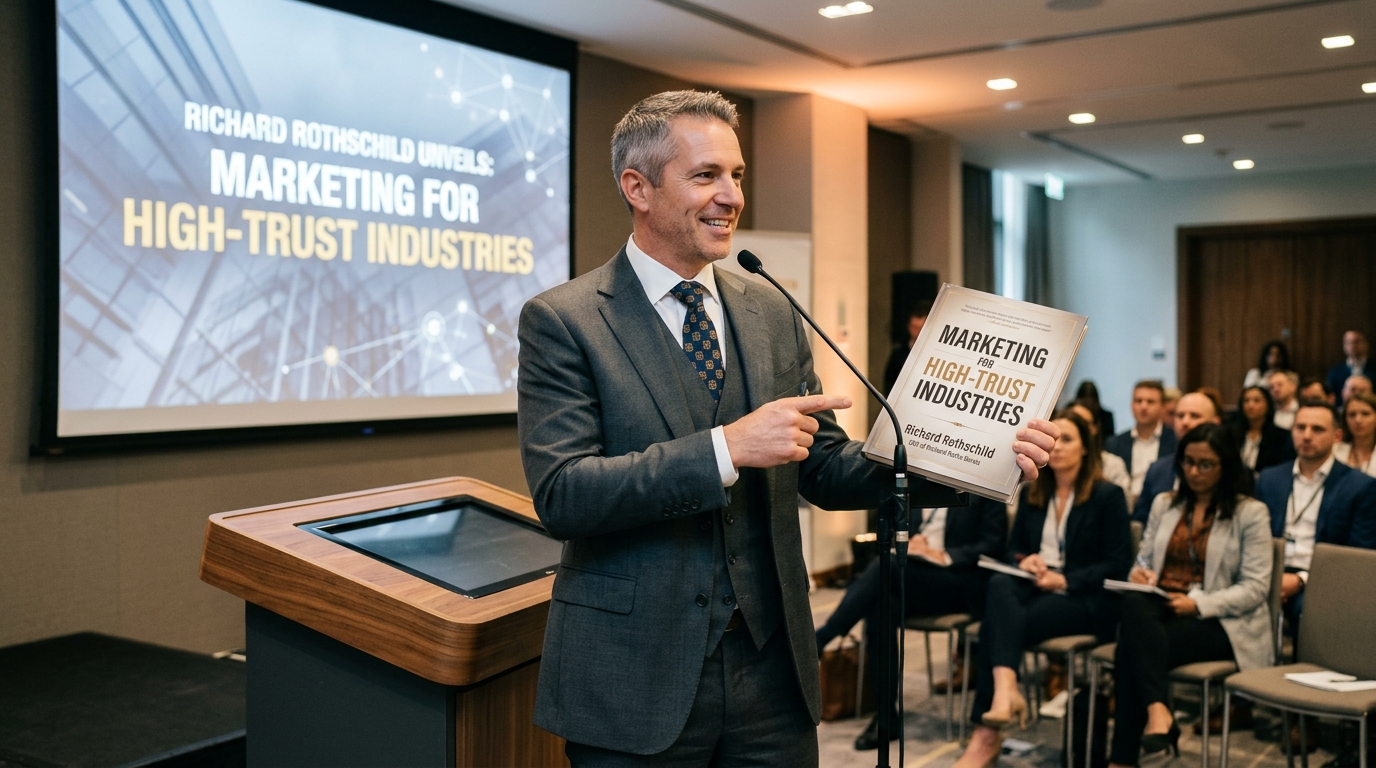
Richard Rothschild’s new book, ‘Marketing for High-Trust Industries,’ tackles the conversion problem that operators in legal, healthcare, banking, and financial services face daily: how do you build a funnel when the cost of a bad decision is high and prospects need credibility before they’ll move? The framework combines behavioral psychology, data analytics, and strategic positioning to create performance-driven systems that prioritize trust over urgency. Rothschild’s methodology rejects traditional advertising models in favor of conversion architecture built on operational efficiency, proof points, and long-term brand positioning.
Key Points:
- High-trust industries require conversion systems that acknowledge friction rather than trying to eliminate it with urgency tactics
- The framework emphasizes data-driven positioning and proof over volume-based advertising—trust is earned through strategic credibility signals, not ad spend
- Sustainable growth in high-consideration categories comes from conversion architecture that de-risks the buyer’s decision at every stage
Why it matters: Most funnel advice assumes low-friction transactions—buy now, regret later, refund if needed. But if you’re selling legal services, financial products, healthcare, or anything where the buyer’s risk is high, that playbook fails. High-trust funnels need a different architecture: longer nurture sequences, more proof at every stage, and positioning that signals expertise before you ever ask for a sale. The lesson here isn’t sector-specific—it’s structural. Any funnel with high consideration (B2B software, coaching, consulting, premium services) benefits from treating trust as a conversion metric. If your funnel relies on scarcity timers and countdown clocks but your prospects need case studies and credentials, you’re optimizing for the wrong behavior. Trust-building isn’t slow marketing—it’s conversion optimization for categories where credibility is the bottleneck.
🎯 How to Lower Friction in High-Consideration Funnels
When the cost of a bad decision is high, prospects don’t convert faster with urgency—they convert when you’ve de-risked their choice. Use case studies at every stage, not just on a testimonials page. Show proof before you ask for the sale. Structure your funnel to answer objections in sequence, not all at once. (Read more)
🎯 Why Your Entry Offer Matters More Than Your Core Product
The lipstick effect proves that when budgets tighten, people still buy—they just buy smaller. Your $47 tripwire isn’t a throwaway offer; it’s the psychological bridge that makes your $497 core product feel attainable. If your funnel treats low-ticket offers as afterthoughts, you’re missing the conversion lever that matters most when uncertainty rises. (Read more)
🎯 Micro-Commitments Build Trust Faster Than Big Asks
Luxury brands didn’t create mini products to be nice—they did it because a $35 candle converts skeptics into buyers faster than a $300 diffuser. The same logic applies to your funnel. A small yes builds confidence for a bigger yes. If your first ask is high-ticket, you’re forcing prospects to trust you before they have evidence you’re worth it. (Read more)
“During financial crises, consumers don’t abandon luxury—they downsize it.”
— Psychology Today, Consumer Behavior Research
What’s your biggest funnel friction point right now?
- A) Getting traffic to convert on the first visit
- B) Moving leads from low-ticket to core offer
- C) Building trust in a high-consideration category
The operators who win in uncertain markets aren’t the ones with the biggest ad budgets—they’re the ones who understand that conversion is a psychology problem, not a traffic problem. When prospects feel cautious, your job isn’t to push harder; it’s to make saying yes feel safer.
Two levers matter more than anything else right now: your entry offer and your trust architecture. Get those right, and the rest of your funnel gets easier.
Until next time,
Funnel Marketing Systems Editor
📊 How did you like today’s email?
Originally published by Funnel Marketing Guy, your resource for funnel marketing, sales funnels, ClickFunnels, lead generation, conversion optimization, email marketing, marketing automation, and digital marketing strategies.
Continue your journey at https://www.funnelmarketingguy.com.
Enjoyed this issue?
Subscribe to get Funnel Marketing System delivered to your inbox every week.
Join 17 other subscribers • Free forever