
Turn Browsers Into Buyers: +237% Conversion Boost
Native ad upgrades, AI-powered CRM, and why trust matters more than ever
|
Welcome to Funnel Marketing System!
Your funnel isn’t broken—your credibility infrastructure is. This week: the trust bottleneck that lead gen can’t solve, the AI automation delivering 237% conversion lifts, and why your funnel actually starts 12 months before you think it does.
- 🎯 MGID’s CPA Tune upgrade: 237% conversion lift vs. manual optimization—and what changed in the engine
- 🔧 HubSpot’s agentic AI bet: self-updating CRM claims 3x win rates as platform economics shift
- 📊 The real estate credibility crisis: why more leads won’t fix a trust problem
- ⏰ Insurance placement wins happen before underwriting—and estate agents miss 40% of buyers who decided a year ago
- 🤖 B2B’s triple squeeze: budget consolidation, Gen Z credibility demands, and the AI search shift
The Upstream Advantage: Why Your Funnel Optimization Starts Earlier Than You Think
Most operators treat funnel optimization as a post-lead activity. You capture the contact, then you optimize qualification, nurture, and conversion. But the highest-leverage optimization happens before someone enters your funnel at all.
Insurance underwriters figured this out first. Munich Re’s data shows placement rates improve most when you optimize applicant mix upstream—before underwriting even starts. Predictive segmentation routes low-risk prospects to accelerated paths while complex cases flow to alternative products. The result: better placement performance without changing a single underwriting rule.
Estate agents are learning the same lesson the hard way. Research shows 40% of buyers decide to move a year or more before contacting an agent. Another 31% are actively considering moves but haven’t reached out yet. If your funnel measurement starts at “lead captured,” you’re missing the majority of your actual market. The optimization opportunity isn’t in your email sequences—it’s in becoming visible and credible during that 12-month decision window when prospects haven’t yet raised their hand.
🔗 MGID Upgrades CPA Tune to Boost Campaign Conversion Rate by Up to 237% Over Manual Optimization (4 minute read)

MGID launched a major upgrade to CPA Tune, its AI-powered bid optimization engine, delivering conversion rates up to 237% higher than manual optimization while reducing cost per conversion by 39%. The enhanced platform analyzed over 30,000 tracked conversions across 13 verticals and 19 markets, producing 13-15% higher conversion rates and 20-25% revenue increases.
Key Points:
- Three core improvements enable faster market response: enhanced real-time signal processing, granular traffic segmentation, and refined interest understanding
- The upgrade works for both Target CPA and MaxConversions strategies with no client-side changes required
- Results are backed by cross-vertical data spanning 19 markets, not single-campaign outliers
Why it matters: This is the CRO benchmark that actually matters—237% lift vs. manual optimization with hard numbers across 30K+ conversions. The upgrade proves AI-driven conversion optimization improves performance when properly instrumented, not just when it obscures it. If your current automation can’t show you what changed in the engine to produce the lift, you’re flying blind.
🔗 HubSpot Unveils Breeze Assistant and Smart CRM (9 minute read)
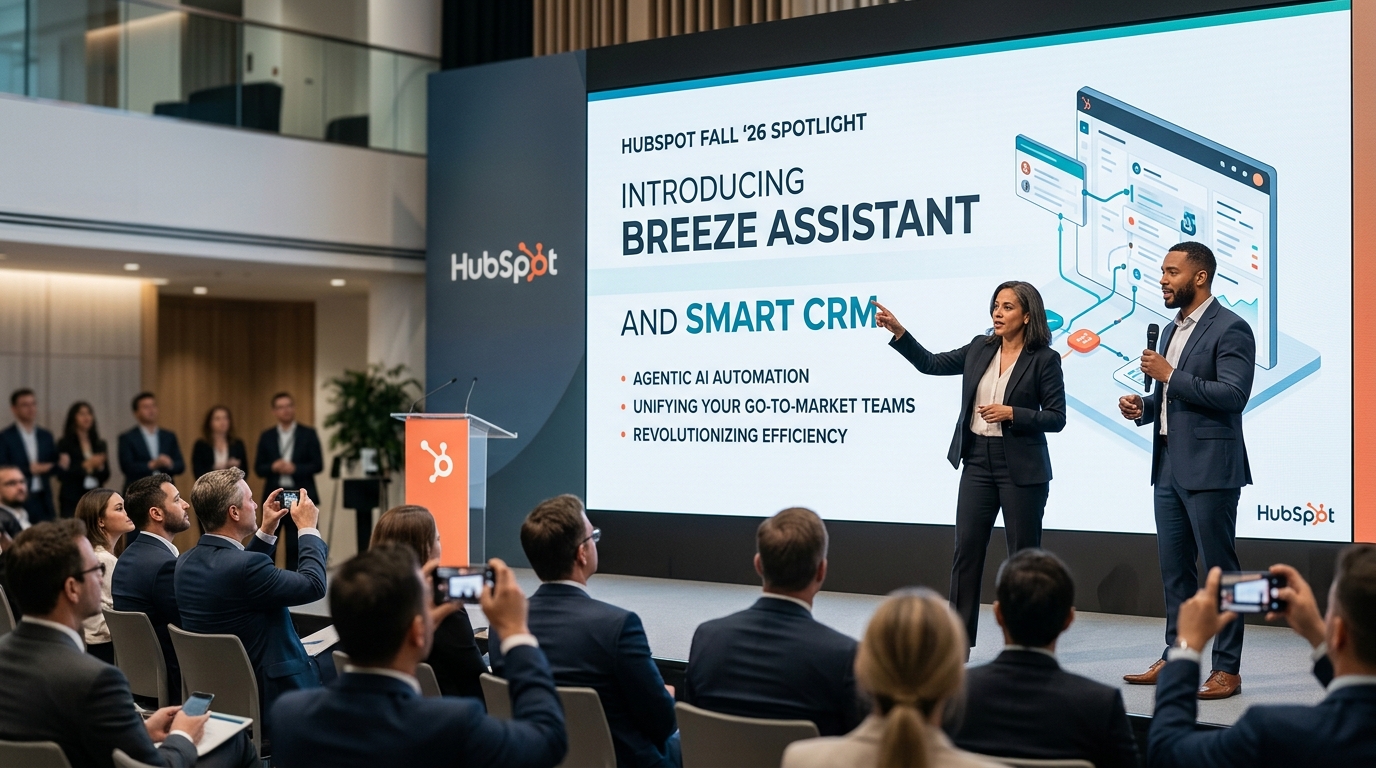
HubSpot’s Fall ’26 Spotlight introduces Breeze Assistant and a self-updating Smart CRM powered by agentic AI automation. The platform now features “Growth Context”—a dynamic layer of business and customer data that automatically captures CRM data, powers Marketing Studio AI agents, and integrates with ChatGPT Ads and Microsoft Advertising. HubSpot claims businesses using Growth Context create 2x more deals, win 3x more deals, and close 2x more tickets.
Key Points:
- Agentic AI represents HubSpot’s strategic pivot following a failed Google acquisition and pressure on its per-seat revenue model
- Growth Context creates first-party data feedback loops connecting acquisition, qualification, and revenue metrics
- The self-updating CRM addresses the chronic data hygiene problem that breaks most marketing automation
Why it matters: HubSpot’s agentic AI bet is either a genuine platform evolution or a response to revenue pressure—probably both. The 3x win rate claim matters because it suggests Growth Context solves the attribution and data loop problems that make most CRMs feel like data graveyards. If the self-updating promise holds, it removes the manual data entry tax that kills adoption. If it doesn’t, it’s just another AI wrapper on the same broken workflows.
🔗 The Real Estate Industry Is Having A Credibility Crisis. Here’s How To Fix It (8 minute read)

Real estate organizations are optimizing the wrong constraint. While most focus on lead generation through ads, funnels, and automation, the actual bottleneck is trust. Consumers face interchangeable messaging—every agent claims local expertise, every brokerage offers support. What differentiates winning organizations is consistent, stable leadership that creates emotional certainty before appointments begin.
Key Points:
- Credibility isn’t a marketing responsibility—it’s an operational standard built through consistent communication and predictable client experiences
- In saturated markets, organizations that feel safest to trust outperform those still trying to win conversations
- Lead generation assumes the constraint is awareness or interest; credibility infrastructure assumes the constraint is trust
Why it matters: This is the contrarian take that challenges default assumptions about funnel optimization. Your funnel isn’t broken—your credibility infrastructure is. More leads won’t fix a trust problem. When buyers can’t differentiate between options, they default to whoever feels least risky. That’s not a conversion rate optimization problem. That’s a brand infrastructure problem that happens before your funnel even starts. For operators in saturated markets, this reframes where to invest: not in more top-of-funnel volume, but in trust signals that make choosing you feel obvious.
“The placement advantage begins before underwriting. Applicant mix matters more than underwriting rules alone.”
— Munich Re, Future of Underwriting Conference
🎯 Have agents been wrong about lead generation?
Estate agents may be fundamentally misunderstanding their market. Research by LRG reveals 40% of people decide to move a year or more before contacting an agent, with 22% taking over two years to act. Only 19% contact agents immediately. Crucially, 31% haven’t spoken to agents about moves they’re currently considering. Personal reasons—family changes and finding the right property—drive action, not financial factors. This challenges how the industry measures market activity: transaction figures are lagging indicators. Your funnel starts 12 months before you think it does, and transaction data is lying to you about market size. (Read more)
🎯 The placement advantage begins before underwriting
Munich Re’s 2026 Future of Underwriting Conference reveals that insurers are applying data-driven insights upstream to optimize lead generation, customer segmentation, and distribution strategies before underwriting begins. By using predictive models to identify prospects likely to qualify and purchase, insurers improve placement rates and reduce friction. The key insight: applicant mix matters more than underwriting rules alone. Advanced segmentation enables multi-path customer journeys, routing lower-risk applicants to accelerated pathways while directing complex cases to alternative products. This integrated approach treats acquisition and underwriting as connected functions rather than separate silos. (Read more)
🎯 Budget Consolidation, Gen Z Buyers, and the AI Shift Redrawing B2B Marketing
B2B marketing faces a triple squeeze: budget consolidation, generational leadership changes, and AI adoption. Companies are consolidating vendor relationships, favoring top-performing providers over multiple agencies. Nearly 90% of B2B marketers recognize the need to influence Gen Z and millennial decision-makers who demand credibility and peer validation. Meanwhile, boards are eliminating CMO roles—often misdiagnosing execution gaps as structural failures. AI and macroeconomics are forcing cuts to both fixed internal costs and variable agency expenses. The result: industry reinvention, rising fractional executive roles, and shifting budgets toward AI search optimization and expert-credibility content strategies. (Read more)
🎯 Eight Agencies Take a New Approach to AI-Powered Marketing
Eight innovative agencies are revolutionizing marketing by embedding AI into core operations rather than adding it to existing services. From Algomarketing’s AI-native agents and team coaching to Intercept’s human-led strategy paired with proprietary AI tools, these agencies demonstrate how forward-thinking firms are reimagining service delivery. Others like Level Agency use AI orchestration for complex buying journeys, while Seer Interactive leverages its AI Lab for research and consulting. The common thread: operationalizing AI at scale rather than experimenting. A widening gap is emerging between agencies embracing AI transformation and those maintaining status quo approaches—which changes how you’ll buy marketing services. (Read more)
🎯 Plivo CPaaS Is Moving Up the Stack: Can It Orchestrate the Whole Customer Journey?
Plivo is evolving from a communications API provider into a customer journey orchestration platform with its 2026 Vibe Agent and Agent Studio launches. The CPaaS category is shifting toward AI-powered workflow coordination across channels, with Gartner including omnichannel orchestration as a key growth driver. While Plivo can build appointment workflows in minutes, real-world healthcare deployments require careful integration with EHR systems, HIPAA compliance, and human handoff logic. The critical test isn’t conversation speed—it’s whether Tuesday’s 3:30 appointment actually gets rescheduled. Success depends on complete journey ownership, proper access controls, and handling failure paths when systems reject updates or clinical issues arise. What happens when your automation stack tries to own the whole journey? The handoff points still break. (Read more)
🎯 A Data-Driven Approach to Practice Financial Health
Hearing care professionals must move beyond viewing revenue as the sole measure of practice health. A data-driven approach connects financial metrics with operational efficiency and patient outcomes, treating them as interconnected rather than competing priorities. Accurate, consistent data is foundational—without it, insights become unreliable. Practices should monitor both leading indicators (forecasting future performance) and lagging indicators (historical results). Key metrics include conversion rates, revenue per provider, return/exchange rates, and appointment utilization. Modern practice management software transforms raw data into actionable insights, identifying revenue leakage opportunities and enabling informed decision-making that simultaneously strengthens financial stability and enhances patient care quality. (Read more)
Which constraint are you actually optimizing?
- A) Lead volume—I need more top-of-funnel traffic
- B) Conversion rates—I have traffic but qualification is broken
- C) Trust and credibility—prospects can’t differentiate between options
- D) Upstream timing—I’m visible too late in the decision cycle
This week’s pattern: AI automation is delivering measurable conversion lifts when properly instrumented, but the bigger shift is happening upstream. Trust infrastructure matters more than lead volume in saturated markets. Funnel optimization is moving earlier—predictive segmentation and applicant mix before qualification. Platform consolidation and agentic AI are reshaping how marketing services are bought and delivered.
The operators winning right now aren’t just optimizing conversion rates. They’re optimizing which prospects enter the funnel in the first place, building credibility infrastructure before the first conversation, and instrumenting their automation so they know what changed when performance improves.
Keep optimizing,
Funnel Marketing Systems Editor
📊 How did you like today’s email?
Originally published by Funnel Marketing Guy, your resource for funnel marketing, sales funnels, ClickFunnels, lead generation, conversion optimization, email marketing, marketing automation, and digital marketing strategies.
Continue your journey at https://www.funnelmarketingguy.com.
Enjoyed this issue?
Subscribe to get Funnel Marketing System delivered to your inbox every week.
Join 17 other subscribers • Free forever