
The Prompt Gap: Why AI Search Is Failing Your Funnel
Your tracking tells you what people search, but not what they actually want
|
Welcome to Funnel Marketing System!
Your customer journey now starts in a place you can’t see—and if you’re not tracking it, you’ve already lost the conversion before it begins.
- 🔍 The prompt gap: why AI search is creating invisible funnel stages
- 🤖 Platform automation is forcing you to fix your data before AI takes over
- 🎯 Conversion fundamentals that work whether AI is involved or not
- 📊 How retail media and AI-assisted commerce are converging into one system
The Invisible Funnel Stage
Your prospects are researching you right now. They’re asking ChatGPT which CRM to buy, prompting Gemini to compare your product to competitors, and getting recommendations from Perplexity before they ever hit your website.
You have zero visibility into any of it.
This is the prompt gap—the distance between how customers actually phrase questions to AI and what your keyword tracking thinks they’re asking. While you optimize for “best email marketing software,” they’re asking “which email tool integrates with Shopify and has good deliverability for e-commerce.” Your brand either shows up in that AI response or it doesn’t. If it doesn’t, the conversion opportunity is gone before traditional tracking even registers a signal.
The forcing function is already here. Google and Meta are retiring manual campaign controls and pushing toward full automation. Platforms want clean conversion data and first-party signals so their AI can optimize toward real business outcomes. But here’s the problem: 85% of companies use AI marketing tools, yet only 53% report meaningful ROI, and just 6% actually act on AI recommendations. The gap isn’t the technology—it’s that most marketers haven’t fixed their data infrastructure or attribution models before handing control to the algorithm.
The tactical response starts with a visibility audit. You need to understand how AI describes your brand, which competitors appear alongside you in responses, and what CX issues are shaping your narrative. Reviews, social conversations, and customer feedback now heavily influence AI outputs. This isn’t SEO—it’s a new top-of-funnel layer that requires signal alignment across search engines and AI platforms simultaneously.
But AI or not, conversion fundamentals still matter. Buyers make emotional decisions first, then justify them logically. Social proof, genuine FOMO with real deadlines, price anchoring, cognitive ease through plain language, and specificity in claims aren’t manipulation—they’re friction removers for buyers already interested in your offer. These principles work on landing pages, in checkout flows, and throughout email sequences regardless of where the prospect originated.
The winners are connecting all of this into a single system. Criteo’s ANZ platform saw 32% year-to-date growth in 2026, with retail media spend surging over 500% annually. AI-referred visits convert 1.5x higher than traditional traffic. That’s not coincidence—it’s the convergence of discovery, attribution, and conversion in unified platform ecosystems.
One warning: Lululemon’s Q2 revenue dropped 4% with comparable sales falling 9% despite significant marketing investment. The lesson isn’t that advertising doesn’t work—it’s that more spend won’t fix a product, retention, or positioning problem. Before you amplify campaigns, diagnose why customers visit and purchase less frequently. Use store-level or funnel-stage data to identify root causes before scaling solutions.
The playbook is shifting from isolated lead metrics to revenue-linked experimentation, from manual campaign controls to AI-optimized outcomes, and from keyword-based tracking to AI visibility management. Your data infrastructure and conversion fundamentals need to be airtight before platforms take over optimization—because once they do, you’re either feeding the algorithm clean signals or garbage.
🔗 The Prompt Gap: Why Keyword-Based AI Search Tracking Misses What Customers Actually Ask (4 minute read)
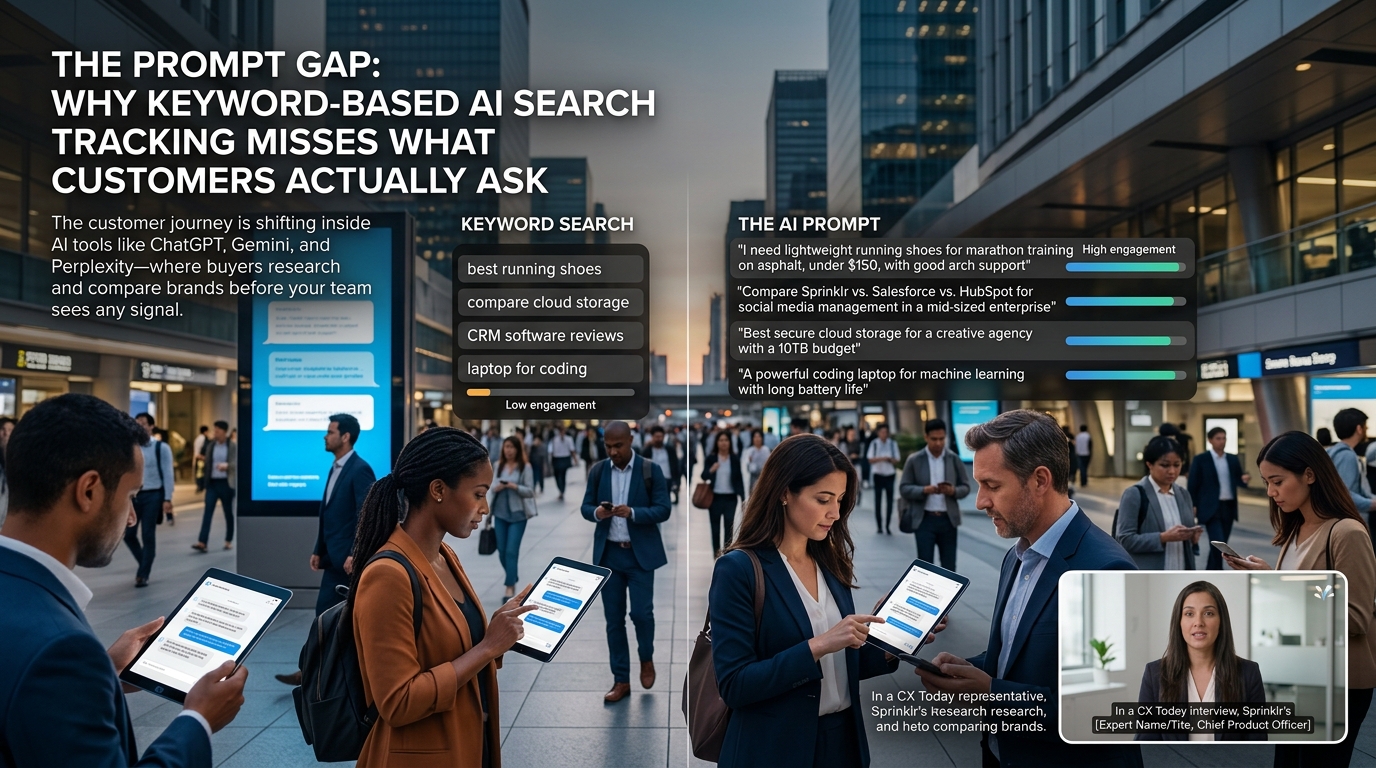
The customer journey is shifting inside AI tools like ChatGPT, Gemini, and Perplexity—where buyers research and compare brands before your team sees any signal. In a CX Today interview, Sprinklr’s Sean Jackson reveals the “prompt gap”: traditional keyword-based tracking misses how customers actually phrase questions to AI, creating a critical visibility blind spot for marketers.
Key Points:
- Reviews, social conversations, and customer feedback now heavily influence how AI describes your brand in responses
- Traditional keyword tracking fails to capture natural language prompts customers use when researching in AI tools
- Conduct a visibility audit to understand your AI representation, identify which competitors appear in AI responses, and spot CX issues shaping your narrative
Why it matters: If you’re optimizing for keyword rankings while prospects research in ChatGPT, you’re fixing the wrong part of the funnel. AI search is creating an invisible discovery stage that happens before any traditional conversion signal appears. Your brand needs to show up in AI responses or the conversion opportunity is lost before it starts. (Read more)
🔗 Explaining AI Marketing (16 minute read)

AI marketing has evolved into three distinct layers: predictive models that automate bidding and targeting, generative systems producing text and creative assets, and agentic software executing multi-step workflows autonomously. Major platforms like Google and Meta are retiring manual controls and pushing toward full automation, but results remain mixed—only 53% of companies report meaningful ROI, and just 6% act on AI recommendations.
Key Points:
- 85% of companies use AI marketing tools, yet only 53% report meaningful ROI—the gap is data infrastructure, not technology capability
- Platforms are forcing automation by retiring manual controls, making clean conversion data and first-party signals critical before AI takes over optimization
- EU regulations now mandate transparency, with AI-labeled ads experiencing 31.5% lower click-through rates, signaling trust challenges
Why it matters: Platforms are forcing the automation decision whether you’re ready or not. If your conversion tracking is messy, your attribution model is broken, or your first-party data is fragmented, AI will optimize toward the wrong goals and amplify existing problems. Fix your data infrastructure before handing control to the algorithm, or you’ll join the 47% seeing weak ROI. This is the forcing function—get your signals clean now. (Read more)
🔗 Sales Psychology in Copywriting: 5 Brilliant Strategies (9 minute read)

Buyers make emotional decisions first, then justify them logically. This guide reveals five psychology-backed strategies that remove friction for prospects already interested in your offer: use social proof strategically throughout your sales page, leverage genuine FOMO with real deadlines, anchor prices to control perception, ensure cognitive ease through plain language, and employ specificity to make claims memorable.
Key Points:
- Social proof works at every funnel stage—testimonials on landing pages, case studies in nurture emails, customer logos at checkout
- Real deadlines create genuine FOMO; fake scarcity destroys trust and damages conversion rates long-term
- Specificity makes claims memorable and believable—“increased revenue by 34% in 90 days” beats “significant growth”
Why it matters: Whether your traffic comes from Google, ChatGPT, or paid social, conversion fundamentals don’t change. These aren’t manipulation tactics—they’re friction removers that help interested buyers make decisions faster. Apply them systematically across landing pages, checkout flows, and email sequences to lift conversion rates regardless of traffic source or platform automation. (Read more)
“Technology amplifies strategy; without proper foundation, it only magnifies existing disconnects.”
— The Financial Brand, on omnichannel execution failures
What’s the biggest blind spot in your current funnel?
- A) AI discovery stage—I don’t know how ChatGPT describes my brand
- B) Data infrastructure—my conversion tracking is messy before AI takes over
- C) Root cause diagnosis—I’m amplifying spend without fixing retention or product issues
- D) Conversion fundamentals—my copy and checkout flow still have friction
The funnel is expanding in both directions. At the top, AI tools are creating discovery stages you can’t track with traditional analytics. At the bottom, platforms are automating optimization and demanding cleaner signals. In the middle, conversion psychology still determines whether interested prospects actually buy.
The winners are diagnosing root causes before scaling spend, fixing data infrastructure before AI takes over campaign management, and connecting discovery visibility to conversion outcomes in unified systems. The losers are adding more tools to broken strategies and wondering why ROI stays flat.
Get your signals clean, audit your AI visibility, and remove friction systematically.
Funnel Marketing Systems Editor
📊 How did you like today’s email?
Originally published by Funnel Marketing Guy, your resource for funnel marketing, sales funnels, ClickFunnels, lead generation, conversion optimization, email marketing, marketing automation, and digital marketing strategies.
Continue your journey at https://www.funnelmarketingguy.com.
Enjoyed this issue?
Subscribe to get Funnel Marketing System delivered to your inbox every week.
Join 17 other subscribers • Free forever