
Stop Wasting Budget: Scale Smarter, Not Harder
Your funnel's broken, your AI's guessing, and one traffic source owns you.
|
Welcome to Funnel Marketing System!
Your ROAS is falling while your ad spend climbs. You’re not alone—and the fix isn’t spending more.
- 🚨 Why retail media spend is up 69% but returns are down 8.1%
- 🤖 AI agents are about to reshape how customers interact with your funnel
- 📊 The lead source diversification framework that reduces CAC risk
- 🔄 How follow-up automation turns aging leads into revenue
- 🎯 First-party attribution that connects spend to closed deals
The Scaling Crisis No One Talks About
Amazon CPC rose 8.4% last year. Brand ROAS fell 8.1%. Retail media spending will hit $69 billion by 2026, yet most brands are earning less per dollar spent than they did two years ago.
This isn’t a retail media problem. It’s a funnel economics problem.
When you pour more budget into the same channels without fixing the underlying conversion mechanics, you’re bidding against yourself in an auction you can’t win. Manual optimization can’t keep pace with real-time marketplace algorithms. Disconnected data wastes spend on out-of-stock products or dead leads. And single-channel dependence turns your entire business into a hostage situation.
The operators winning right now aren’t spending more. They’re building diversified lead portfolios, implementing AI-assisted optimization with human oversight, and measuring revenue quality instead of vanity metrics. They’re treating funnel infrastructure like business risk management—because that’s exactly what it is.
🔗 Marketing Has a Scaling Problem: More Spend isn’t Driving Better Returns (6 minute read)
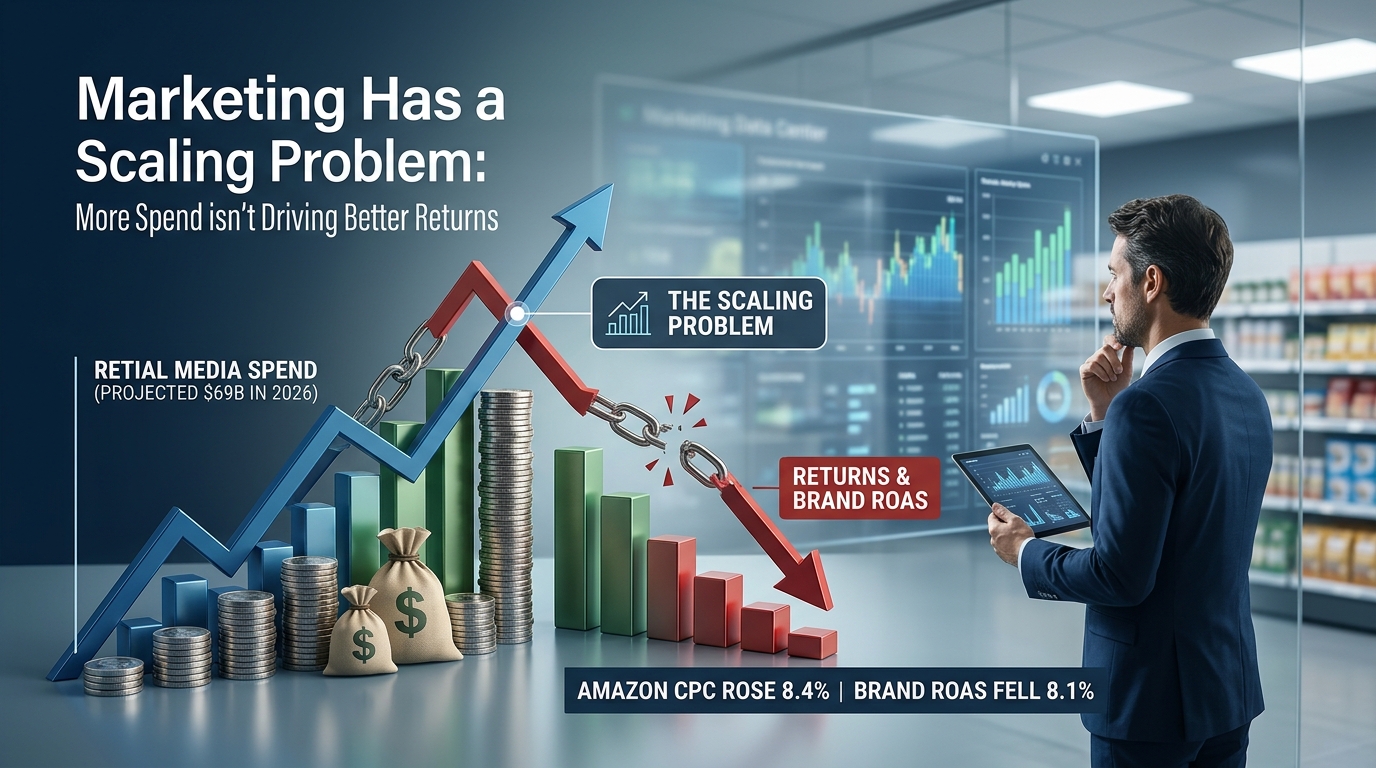
Retail media spending is projected to hit $69 billion in 2026, yet returns are collapsing. Amazon’s CPC climbed 8.4% while brand ROAS dropped 8.1%, exposing a fundamental scaling crisis. CPG brands now allocate 84% of their budgets to Amazon and Walmart, intensifying competition and driving costs skyward while manual optimization strategies fail to match real-time marketplace algorithms.
Key Points:
- Manual bid management can’t compete with algorithmic marketplaces that adjust pricing in milliseconds
- Disconnected media and shelf data waste budgets advertising out-of-stock products
- AI shopping agents like Amazon’s Alexa for Shopping are reshaping product discovery, requiring brands to optimize for both search and AI recommendations
Why it matters: This is the exact problem your funnel team faces at scale—more spend doesn’t automatically drive better returns. The retail media crisis proves that channel saturation + manual optimization = declining efficiency. The solution isn’t bigger budgets; it’s AI-powered continuous optimization that adjusts bids in real-time, aligns inventory signals with media spend, and captures visibility across multiple discovery surfaces. Brands still running manual campaigns are competing with one hand tied behind their backs.
🔗 When AI Agents Meet: The Customer Journey Is About to Change (12 minute read)

AI agents are fundamentally reshaping customer experience by operating independently on behalf of customers. Instead of humans navigating your website and funnel, customer AI agents will soon query, compare, and transact directly with your enterprise systems. This shift transforms what “customer experience” means—APIs, data quality, and machine-readable information become experience concerns, not just technical infrastructure.
Key Points:
- Customer AI agents will access broader life context than any single brand can track, fundamentally changing personalization strategies
- Businesses must become discoverable and credible to machines, not just humans—competing for agent selection through reliable systems and trustworthy authorization
- CX leaders must redesign around agent-to-agent interactions rather than optimizing human interfaces
Why it matters: Your funnel was built for human browsers. AI agents don’t care about your hero image or social proof placement—they evaluate structured data, API reliability, and authorization frameworks. This isn’t a distant future scenario; it’s happening now. If your product information isn’t machine-readable, if your checkout process requires human navigation, if your data quality is inconsistent, you’re invisible to the next generation of customers. Funnel teams must start thinking API-first, building structured data layers, and ensuring systems can respond to automated queries at scale. The winners will be the brands whose infrastructure can serve both human buyers and their AI representatives.
🔗 Why Lead Source Dependence Is Killing Real Estate Businesses (10 minute read)

Real estate agents are making a critical strategic error: building their entire business around a single lead source like Zillow. While this initially feels stable, it creates dangerous vulnerabilities. When you depend on one platform, you lose control of your marketing strategy, can’t compare profitability metrics across channels, and your growth becomes limited by that company’s pricing decisions.
Key Points:
- Platforms raise costs once agents become dependent, squeezing margins without alternative options
- Single-channel businesses can’t benchmark performance or identify which lead sources actually drive profitability
- Diversified lead portfolios spread risk across Google Ads, Meta, content, referrals, and email nurture—each serving different pipeline stages
Why it matters: This isn’t a real estate problem; it’s a funnel economics problem. Any business dependent on a single paid acquisition channel is one algorithm change or price increase away from catastrophic CAC inflation. The solution is treating lead generation like an investment portfolio—diversify across channels with different risk profiles and time horizons. Some sources (paid search) create immediate deals; others (content, email) build long-term pipeline. Track CAC and LTV by source, not blended averages. Build owned channels (email list, organic content) that can’t be repriced by external platforms. Single-channel dependence isn’t a strategy; it’s a business risk masquerading as simplicity.
🔗 Rhino Precision Marketing Examines How Follow-Up Automation Is Changing the Management of Older Leads (7 minute read)

Rhino Precision Marketing reveals how follow-up automation is revolutionizing lead management by reconnecting with older prospects. Many businesses abandon leads that don’t convert immediately, missing opportunities where timing—not disinterest—caused delays. Automated systems create structured touchpoints without manual effort, allowing companies to segment leads and send contextually relevant messages based on behavior signals.
Key Points:
- Automation identifies when prospects become active again, flagging them for human follow-up rather than continuing automated sequences
- Response pattern analysis provides insights to refine future messaging and timing strategies
- The hybrid approach combines technology’s consistency with human judgment for high-intent signals
Why it matters: Your old leads aren’t dead—they’re just waiting for the right moment. Most funnel teams treat non-converters as lost opportunities, but timing is often the only barrier. Automated re-engagement sequences keep your brand present without burning sales team bandwidth, while behavioral triggers (email opens, link clicks, repeat visits) signal when a lead is ready for human conversation. The key is segmentation: not every aging lead gets the same treatment. Build sequences that adjust based on original source, engagement level, and time since last interaction. Then use automation to surface the high-intent signals your team should prioritize. This turns your database from a cost center into a revenue asset.
🔗 Customer Journeys at Capital One: Observability from Business Impact to Root Cause (9 minute read)
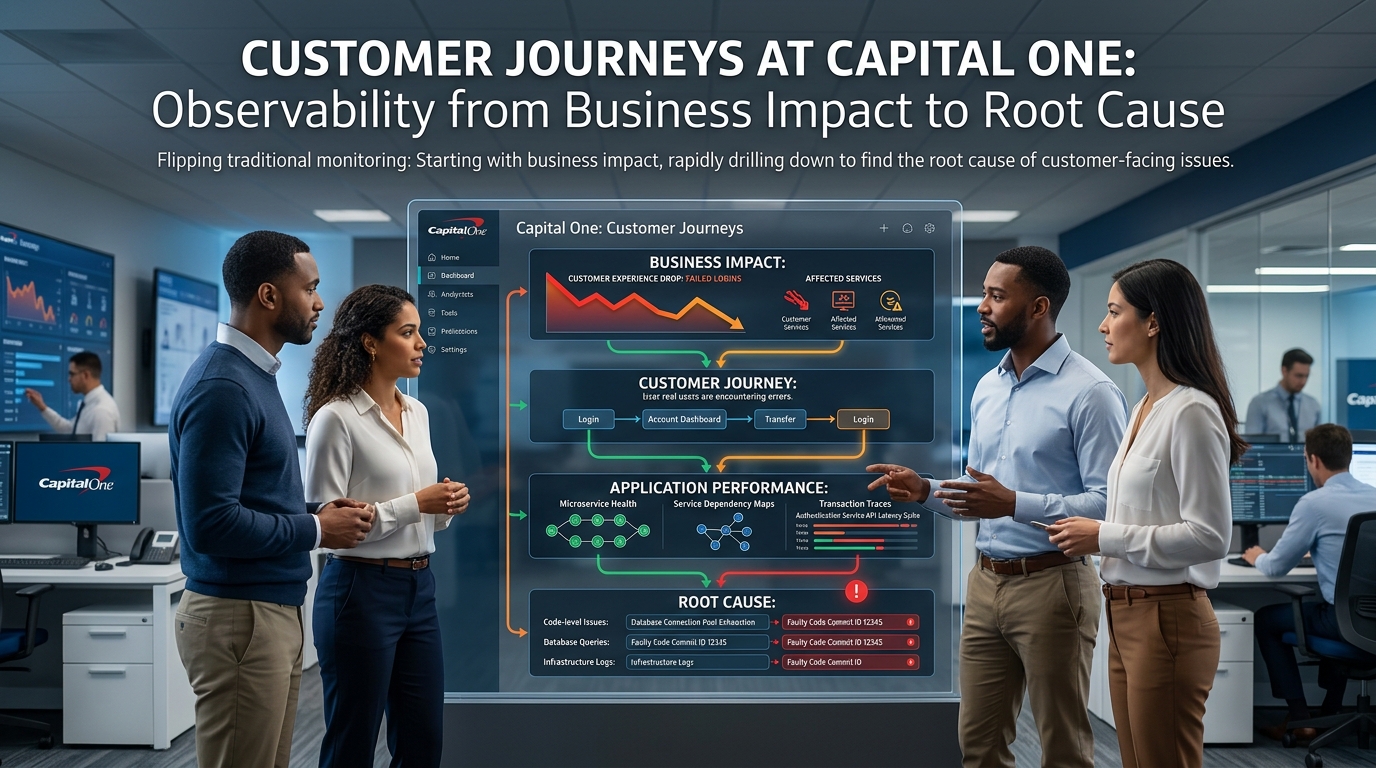
Capital One revolutionizes incident response by flipping traditional observability upside down. Instead of starting with infrastructure alerts and estimating customer impact afterward, their journey-first approach begins with customer interactions and drills down to root cause. Using Observe by Snowflake, they map customer journeys as graphs showing how users navigate experiences, overlaying health signals to immediately quantify business impact.
Key Points:
- Traditional observability starts with technical alerts; journey-first starts with customer impact and works backward to failing services
- AI SRE accelerates analysis 4-10x by autonomously traversing the observability context graph to deliver guided root cause analysis in seconds
- The methodology transforms chaotic investigations into structured procedures with clear business impact quantification
Why it matters: Stop starting with traffic reports. Start with revenue impact and work backward to find the leak. Most funnel teams diagnose conversion problems by looking at channel performance or page-level analytics first, then trying to guess customer impact. Capital One’s approach shows the better path: map the customer journey by stage, overlay conversion health signals, identify where drop-off is happening, then drill into the specific technical or messaging failure causing it. This means your Monday morning funnel review starts with “we lost $47K in expected revenue at checkout yesterday” instead of “mobile traffic was down 3%.” One statement drives urgency and focus; the other drives guesswork. Build your analytics stack to answer “what broke and how much did it cost” before you answer “which page had the problem.”
🔗 Service Glow Debuts GlowIQ First-Party Attribution Platform (5 minute read)

Service Glow has launched GlowIQ™, a first-party attribution platform designed specifically for home service companies like HVAC, plumbing, and electrical contractors. The platform solves a critical industry problem by connecting ad spend directly to closed revenue, consolidating data from websites, phone calls, forms, chat, CRM systems, and advertising platforms into a single attribution model built on first-party data architecture.
Key Points:
- Tracks the complete customer journey from initial contact through job completion, not just lead generation
- Consolidates multi-touch attribution across web, phone, form, and chat interactions into unified revenue reporting
- Provides operators with clear visibility into which marketing investments generate actual returns, addressing measurement gaps in traditionally underserved verticals
Why it matters: This is why first-party attribution beats platform reporting. Google Ads tells you about clicks and conversions. Your CRM tells you about closed deals. But nothing connects the two with the fidelity needed to make real budget decisions. GlowIQ’s architecture—consolidating web, phone, form, chat, CRM, and ad platform data—is the model every funnel team should build toward. The home services vertical is specific, but the problem is universal: multi-touch attribution that tracks to revenue, not just lead volume. If you can’t connect a specific ad dollar to a specific closed deal, you’re optimizing for activity instead of outcomes. Build the infrastructure to measure revenue quality by source, not just lead quantity.
“The companies that win don’t spend more. They measure better, diversify smarter, and automate the repeatable while keeping humans in control of the strategy.”
— Funnel Marketing Systems Editor
What’s your biggest funnel bottleneck right now?
- A) Lead quality from paid channels
- B) Follow-up and nurture automation
- C) Attribution and revenue tracking
- D) Conversion rate at key funnel stages
The through-line across every piece in this issue is the same: funnel teams must shift from single-channel dependence and manual optimization to diversified systems, better measurement, and AI-assisted automation with human oversight. More spend without better infrastructure just accelerates the bleeding.
The operators who survive the next 18 months will be the ones who treat funnel economics like business risk management—building redundancy into lead sources, implementing first-party attribution that tracks to revenue, and using automation to surface high-intent signals instead of replacing judgment. Start with one: diversify your lead portfolio, build your attribution stack, or implement re-engagement automation for aging leads.
Until next time,
Funnel Marketing Systems Editor
📊 How did you like today’s email?
Originally published by Funnel Marketing Guy, your resource for funnel marketing, sales funnels, ClickFunnels, lead generation, conversion optimization, email marketing, marketing automation, and digital marketing strategies.
Continue your journey at https://www.funnelmarketingguy.com.
Enjoyed this issue?
Subscribe to get Funnel Marketing System delivered to your inbox every week.
Join 17 other subscribers • Free forever