
Stop Leaving Conversions on the Table: Your AI-Powered Roadmap

|
Welcome to Funnel Marketing System!
Your linear funnel is dead—and 80% of your competitors haven’t noticed yet. Here’s what’s replacing it.
- 🧠 Why agentic AI just killed your funnel model (and what conversation-based systems look like)
- 📊 The attribution gap: why $300B in ad spend is measured wrong
- 🔍 AI Overviews are eating 27.9% of manufacturing search traffic—here’s your defense
- 🤖 What AI automation actually looks like in B2B workflows today
The Linear Funnel Is Failing—Here’s the Math
Your funnel assumes buyers move in straight lines: awareness → consideration → decision. But 80% of AI-driven analytics projects fail because they’re still measuring clicks instead of intent loops.
The paradigm shift isn’t subtle. Autonomous AI agents are making buying decisions, researching solutions, and evaluating vendors without ever touching your landing pages. Your page funnel metrics—bounce rate, session duration, form submissions—are measuring the wrong universe.
The new model tracks conversation funnels: containment rates (did the AI agent get what it needed?), sentiment trajectories (is trust building or eroding?), and anticipation signals (is the system predicting needs before they’re articulated?). If you’re still optimizing for page-to-page conversion, you’re running last year’s playbook in a game with new rules.
This isn’t theoretical. Companies adopting conversation-based analytics are implementing the MELT framework—Metrics, Events, Logs, Traces—to audit autonomous decisions and prevent hallucinations. Your next funnel audit needs to answer: where are AI agents entering our system, what are they learning, and are we building or destroying trust in those interactions?
🔗 How Agentic AI is changing your analytics and what do to about it (8 minute read)

Agentic AI is rendering traditional linear funnel models obsolete as autonomous agents become decision-making workforce members. The $52.62 billion market opportunity faces a critical trust barrier—80% of AI projects fail because analytics haven’t evolved from tracking clicks to understanding intent and reasoning loops.
Key Points:
- Organizations must adopt the MELT framework (Metrics, Events, Logs, Traces) and replace page funnels with conversation funnels that track containment rates, sentiment trajectories, and trust signals
- Success requires auditing autonomous decisions, preventing hallucinations, and measuring anticipation, forgiveness, and transparency—transforming analytics into enterprise trust architecture
- Key metrics shift from page views and sessions to containment rates (did the agent get what it needed), sentiment trajectories (is trust building), and anticipation signals (predicting needs before articulation)
Why it matters: If you’re still optimizing for page-to-page conversion while AI agents research and evaluate vendors without touching your landing pages, you’re measuring the wrong universe. The 80% failure rate isn’t a technology problem—it’s an analytics model problem. Conversation funnels and trust metrics are the new conversion KPIs for AI-hybrid customer journeys, and adopting them now creates a 2-3 year lead while competitors wonder why their funnel metrics stopped correlating with revenue.
🔗 Measuring US Digital Ad Effectiveness: Attribution, Analytics and ROI (13 minute read)
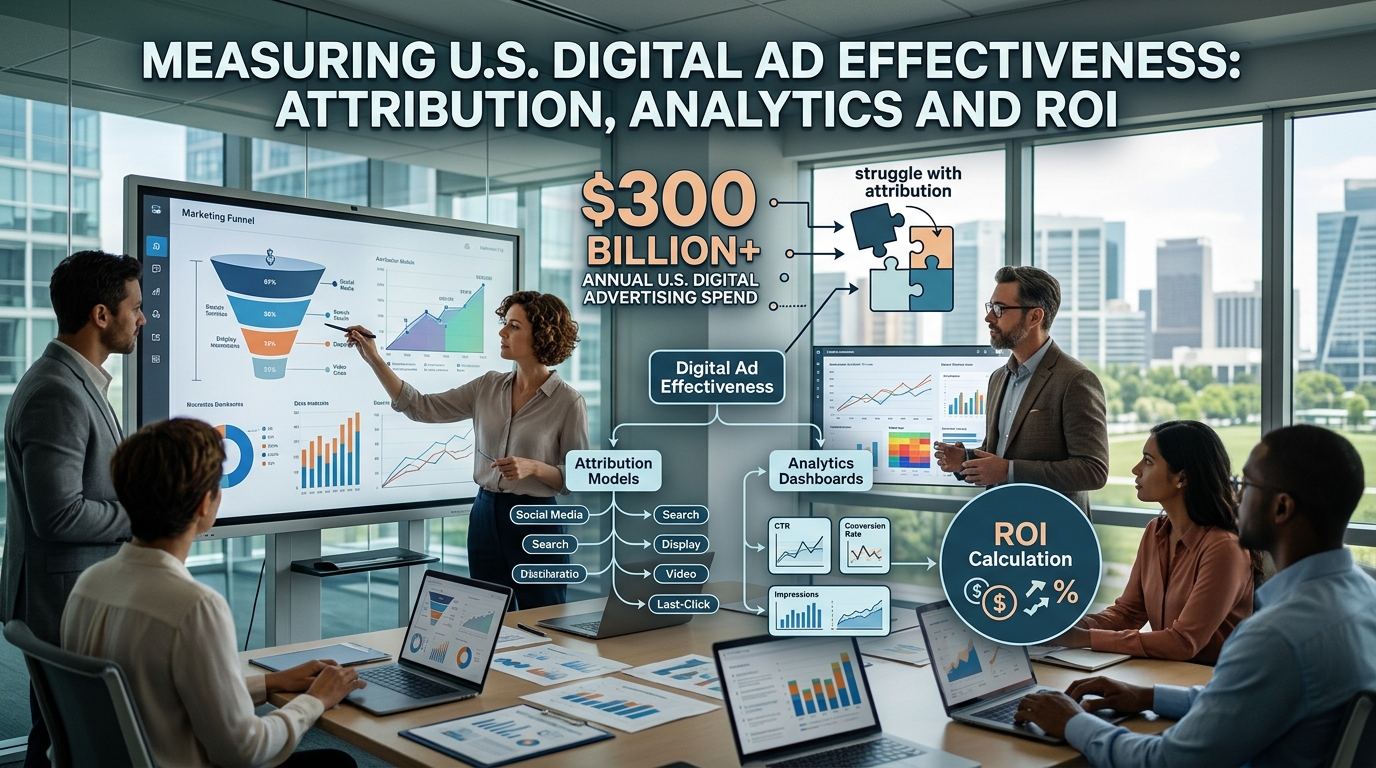
US digital advertising exceeds $300 billion annually, yet most marketers still rely on last-click attribution—a model that systematically favors search and retargeting while starving awareness channels. The article breaks down five attribution approaches with their trade-offs: last-click, first-click, linear, time-decay, and position-based models, plus advanced methods like data-driven attribution and incrementality testing.
Key Points:
- Data-driven attribution uses machine learning but requires 3,000+ monthly conversions—a concrete threshold that determines whether you can move beyond rules-based models
- Incrementality testing measures true causal impact through holdout groups, answering the only question that matters: would this conversion have happened without the ad spend?
- Each method trades simplicity for accuracy: last-click is easy but wrong, incrementality testing is accurate but complex, and your funnel maturity determines which model fits your current capability
Why it matters: The $300B waste problem isn’t about spending too much—it’s about measuring wrong and optimizing for the wrong channels. If you’re using last-click attribution with a multi-touch funnel, you’re systematically defunding the top-of-funnel content that builds trust and over-investing in bottom-funnel tactics that capture existing demand. The 3,000-conversion threshold gives you a clear decision point: below it, use position-based models; above it, invest in machine learning attribution. This is the measurement infrastructure needed to optimize AI-hybrid customer journeys where buyers interact with your brand across human and AI touchpoints.
🔗 What a 188,000-query analysis reveals about AI overviews in manufacturing (7 minute read)
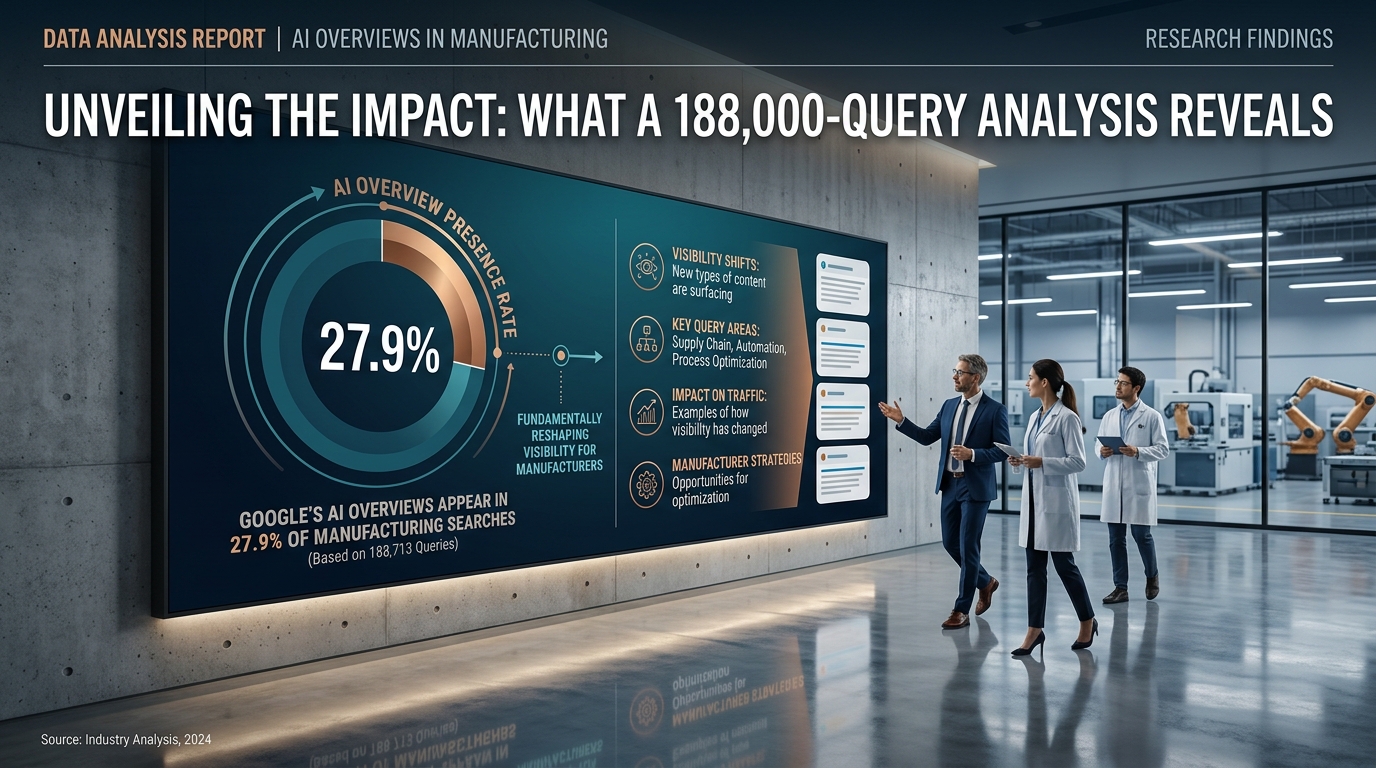
A comprehensive analysis of 188,713 manufacturing queries reveals Google’s AI Overviews appear in 27.9% of searches, fundamentally reshaping visibility for manufacturers. The research identifies a critical pattern: longer queries (7+ words) and informational searches trigger AI Overviews most frequently—precisely the educational content that builds buyer trust at the top of your funnel.
Key Points:
- Brand and location modifiers act as protective shields, significantly reducing AI interference—concrete tactical defenses you can implement today
- Four mitigation strategies: strengthen local SEO signals, create non-text content (video, interactive tools), establish authority through expert credentials and schema markup, and leverage PPC to maintain visibility
- Manufacturers maintaining strong local presence and diverse content formats can offset AI-driven visibility challenges while competitors lose 28% of their top-of-funnel traffic
Why it matters: AI search is killing the educational content that builds trust—the how-to guides, comparison articles, and problem-solution explainers that move buyers from awareness to consideration. If 27.9% of your SEO-driven lead generation is getting displaced by AI Overviews that don’t link to you, your top-of-funnel is bleeding. The brand and location modifier insight is immediately actionable: optimize for “[your brand] + [solution]” and “[solution] + [your city]” queries to create protective moats. This is the wake-up call for B2B funnel operators who built lead generation on educational SEO.
📈 Trending: Tools & Tactics
-
Infintech’s Four-Phase Testing Framework: Comprehensive CRO guide with 30-day implementation roadmap showing how improving conversion from 2% to 4% doubles revenue without increasing ad spend—cutting CAC in half
-
HRS Agency’s AI-Powered Workflows: Real-world implementation of automated outreach, CRM integration, and ML-driven behavior prediction for B2B lead generation—what AI automation looks like beyond the theory
-
Web Canvas Lightweight CRM: Counterpoint to bloated marketing stacks, prioritizing simplicity that enables faster funnel iteration for SMB operators with planned workflow automation features
-
C3.ai’s Quality-Over-Volume Pilot Strategy: Enterprise AI company tightening conversion strategy by pre-qualifying pilots with clearer economic benefits—lessons on optimizing for conversion probability versus pipeline bloat
🎯 The Math Behind Doubling Revenue Without Traffic Growth
Infintech’s CRO guide reveals the compounding math most marketers miss: improving conversion rate from 2% to 4% doesn’t just double conversions—it cuts customer acquisition cost in half. Industry benchmarks show top performers achieve 5.31% conversion versus 2.35% median, and companies using systematic testing see 49% average year-over-year improvements. The four-phase framework (audit, hypothesis, test, scale) with eight data-backed strategies provides a 30-day roadmap that makes conversion optimization a higher-return investment than traffic acquisition. (Read more)
🎯 Advanced Journey Mapping at Enterprise Scale
Researchers developed a framework combining Latent Dirichlet Allocation, hierarchical clustering, and Markov chain analysis to identify behavioral patterns from massive event logs—tested on 120,000+ users generating 5.5 million daily events. This is what’s under the hood of tools claiming to optimize customer journeys: LDA for pattern detection, Markov chains for predicting drop-offs, and hierarchical clustering to segment behaviors. The data science behind AI-driven funnel evolution shows how enterprise-scale journey mapping actually works, detecting irregular behaviors and predicting undesirable outcomes before they happen. (Read more)
🎯 Brand Identity as Friction Reducer in the Funnel
Blacksmith Agency’s research reveals cohesive branding reduces sales friction by eliminating buyer doubt, premium visual design justifies higher pricing, and timeless identities project stability crucial for finance and healthcare sectors. The finding performance marketers often miss: visual credibility shortens the consideration stage and enables premium pricing—top-of-funnel optimization that compounds through every subsequent stage. Companies with generic or outdated visuals face measurable ROI drops because brand acts as a trust proxy in early-stage evaluation. (Read more)
“The companies that will win in the next decade are those that understand AI agents aren’t replacing customers—they’re becoming customers. Your funnel needs to convert both.”
— Deloitte Digital Analytics Research Team
Which attribution model are you currently using?
- A) Last-click attribution
- B) Multi-touch or position-based
- C) Data-driven or incrementality testing
- D) Honestly not sure what we’re using
The funnel isn’t dying—it’s evolving from a linear path to a trust architecture. AI agents are entering your system, evaluating your solutions, and making recommendations without filling out a single form. The operators who win are the ones measuring conversation containment instead of page views, tracking sentiment trajectories instead of bounce rates, and building systems that earn trust from both human buyers and the AI agents researching on their behalf.
Next issue: we’re breaking down the economics of freemium funnels—when giving away the product accelerates growth, and when it just bleeds cash.
Keep converting,
Funnel Marketing Systems Editor
📊 How did you like today’s email?
Enjoyed this issue?
Subscribe to get Funnel Marketing System delivered to your inbox every week.
Join 17 other subscribers • Free forever