
Stop Leaking Sales: The Funnel Fixes You Need
Your conversion killers revealed—plus what actually drives B2B growth
|
Welcome to Funnel Marketing System!
More automation doesn’t mean more revenue—and the data finally proves it. This week: why high-performers are hitting the brakes on automated lead generation, and what they’re building instead.
- 🚨 The automation paradox: why automated lead gen correlates negatively with revenue in top performers
- 🔍 The hidden funnel leak costing you 59% of traffic (it’s not your landing page)
- 🧠 From rules-based workflows to AI-orchestrated individualized journeys
- 📊 Measurement evolution: abandoning MQLs for pipeline velocity and incrementality
- ⚖️ Three guardrails that separate sustainable automation from efficiency theater
The Automation Reality Check
You’re not imagining it. Your marketing stack got more sophisticated, your lead volume went up, but your pipeline stayed flat—or worse, declined.
Here’s why: AI accelerates poorly designed funnels. Most operators are optimizing for activity metrics (MQLs, email sends, lead volume) while their buyers have fundamentally changed how they research, compare, and decide. The result is a measurement problem masquerading as an execution problem.
The winners in 2027 won’t be running more automation. They’ll be running smarter systems—AI-native platforms that observe behavioral signals, make decisions in real-time, and optimize for revenue rather than vanity metrics. They’ll measure pipeline velocity instead of lead volume, and they’ll build connected buyer journeys instead of isolated channel tactics.
🔗 Automated lead generation linked to weaker revenue growth in exploratory firm-level study (9 minute read)

A groundbreaking study published in Discover Artificial Intelligence challenges the core assumption driving most AI marketing adoption: that automation uniformly boosts revenue. Researchers analyzed 50 firms using quantile regression and uncovered a surprising finding—automated lead generation showed a negative association with revenue growth, particularly among high-performing firms.
Key Points:
- The original model included variables that were mathematical functions of revenue growth itself, creating artificial inflation—after correction, the R-squared dropped from 0.935 to 0.137
- Most AI marketing variables showed no statistically significant relationship with performance when properly measured
- High-performing firms experienced negative correlation between automated lead generation and revenue growth, suggesting quality-versus-quantity tradeoffs
Why it matters: This is the data that should stop every “we need more automation” conversation in its tracks. The study reveals what operators already feel: more leads doesn’t mean more revenue when those leads are lower quality, poorly qualified, or misaligned with your actual ICP. The firms winning with AI aren’t automating lead volume—they’re automating qualification, routing, and personalization at the individual buying-group level. The difference between optimizing for MQLs and optimizing for pipeline velocity just became statistically significant.
🔗 7 B2B marketing shifts that will define 2027 (14 minute read)
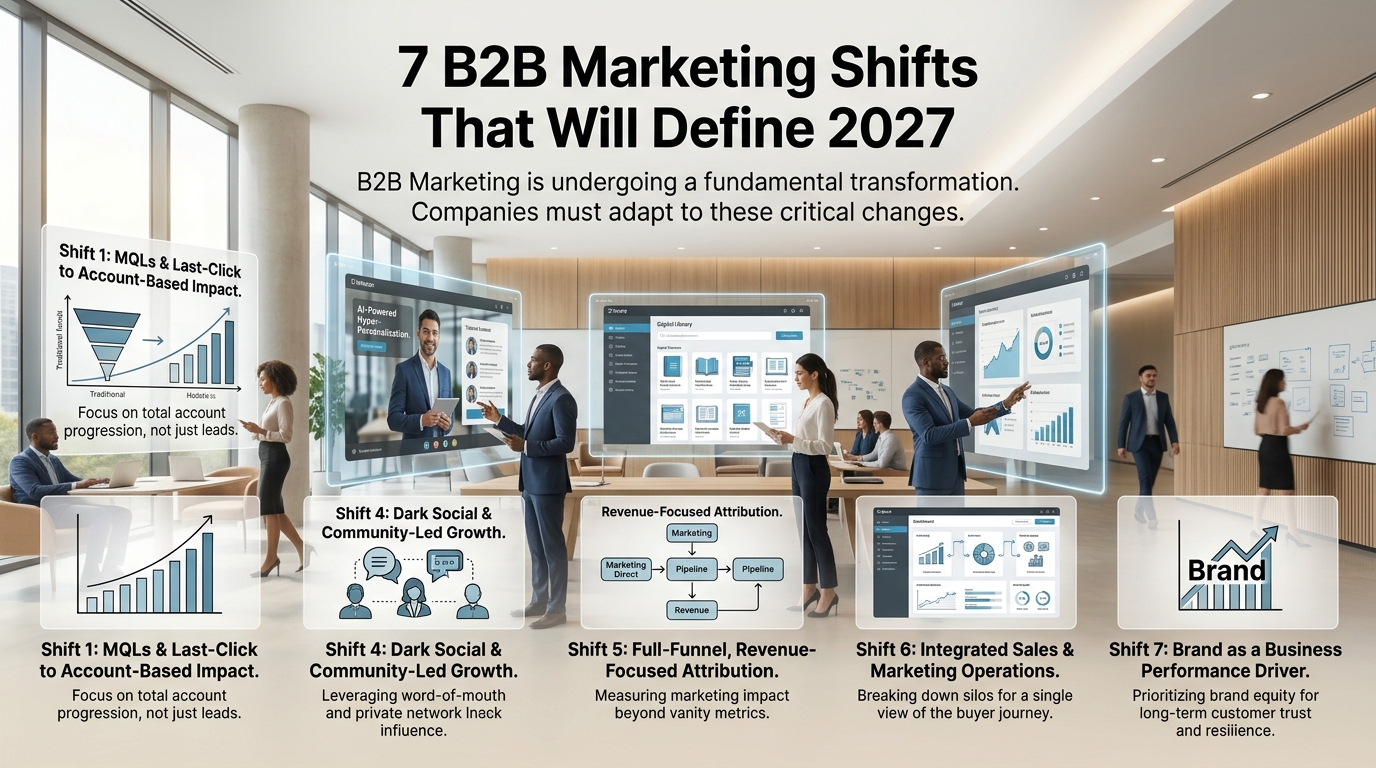
B2B marketing is undergoing a fundamental transformation, and the metrics you’re currently reporting to your CFO are about to become irrelevant. This comprehensive framework outlines seven strategic shifts required to match how buyers actually research and decide in 2027, starting with the death of MQLs and last-click attribution.
Key Points:
- 61% of buyer journeys complete before any vendor engagement—your funnel doesn’t start when you think it does
- Brand authority now drives pipeline velocity; companies must shift from chasing search volume to earning AI citations and becoming the source other sources cite
- Success requires measuring share of citation, pipeline velocity, and revenue attribution—metrics that speak CFO language rather than marketing vanity metrics
Why it matters: This is the measurement revolution. If you’re still optimizing for MQLs, you’re optimizing for a metric that has zero correlation with revenue in most B2B contexts. The article provides the strategic framework for speaking CFO language while building funnels that match actual buyer behavior: connected journeys across buying groups, brand authority that generates inbound at scale, and revenue attribution that survives budget scrutiny. The shift from channel silos to audience funding, from generic AI content to trusted creator voices, and from product marketing to buying-group orchestration—this is the roadmap for operators who want their funnels funded in 2027.
🔗 Time for Marketing Automation to move on! Here comes a new platform - will be it be your fave? (10 minute read)

Jon Miller, former Marketo CMO and marketing automation pioneer, has launched Phave—an AI-native platform that represents a fundamental reimagining of how marketing automation should work. Instead of hard-coded if-then workflows, Phave uses AI-generated “playlists” to create individualized 30-day contact sequences, combining marketing automation with account-based marketing to manage buying groups holistically.
Key Points:
- Legacy platforms like Marketo carry technical debt that prevents true AI integration, creating opportunity for AI-native alternatives built from scratch
- Phave shifts the marketer’s role from workflow-builder to strategist—you define objectives and guardrails, AI orchestrates execution
- The platform combines marketing automation with ABM, managing buying groups and contacts as connected entities rather than isolated records
Why it matters: This is the build-versus-buy decision every operator faces in 2027: patch your legacy platform or migrate to AI-native systems designed for how marketing actually works now. Miller’s thesis is that Marketo and similar platforms can’t compete because their architecture was designed for a rules-based world—adding AI features on top doesn’t solve the fundamental limitation. The shift from marketer-as-workflow-builder to marketer-as-strategist changes what’s possible: instead of spending hours building complex branching logic, you define the outcome and let AI figure out the individual path for each contact. The question isn’t whether this model wins—it’s how long your current platform can compete before technical debt makes migration inevitable.
🔗 Funnel Marketing Software Emphasizes Confusing Pages Leak Online Sales (4 minute read)

A Nosto survey reveals the hidden funnel leak most operators ignore while obsessing over landing page CTAs: 59% of shoppers abandon e-commerce sites due to poor search functionality, and 40% find AI assistants more helpful than retail search tools. FunnelMarketingSoftware.com applies these insights to entrepreneurs building webinars, challenges, and sales funnels.
Key Points:
- Specific search frustrations include: 70% need exact search terms, 66% see repetitive results, and 64% receive irrelevant matches
- Confusing pages, unclear navigation, and complex forms create “leaks” in the customer journey that bleed revenue before prospects reach your offer
- Solutions include clear page structure, descriptive titles, logical headings, and focused call-to-action buttons that reduce friction at each step
Why it matters: This is the search-as-conversion-bottleneck problem. You’re spending budget driving traffic to pages that leak 59% of visitors before they ever see your offer—not because your copy is weak, but because they can’t find what they’re looking for. The rise of AI assistants as preferred search tools (40% preference) signals a broader shift toward conversational, intent-driven navigation. The operators winning in this environment aren’t just optimizing landing pages—they’re rethinking site architecture, implementing semantic search, and reducing cognitive load at every step from entry to conversion.
“The real opportunity lies in connecting AI use cases around buying group signals.”
— Demandbase and Demand Gen Report Research
What’s the biggest funnel leak in your current system?
- A) Poor search/navigation losing traffic before they see the offer
- B) Disconnected AI tools that don’t share data or optimize for revenue
- C) Measuring vanity metrics (MQLs, email opens) instead of pipeline velocity
- D) Legacy automation platform with technical debt preventing real AI integration
The automation paradox is real, and the data finally proves it. High-performing firms are hitting the brakes on automated lead generation—not because automation doesn’t work, but because they’re automating the wrong things while measuring the wrong outcomes.
The path forward isn’t less AI. It’s smarter AI: systems that observe behavioral signals, orchestrate individualized journeys, and optimize for revenue rather than activity. It’s measurement frameworks that speak CFO language. And it’s strategic guardrails—empathy, integration, and trust—that separate sustainable automation from efficiency theater.
Your move: audit your current automation against pipeline velocity, not lead volume. If your AI tools aren’t sharing data and optimizing for connected buying-group journeys, you’re running faster in the wrong direction.
Keep building,
Funnel Marketing Systems Editor
📊 How did you like today’s email?
Originally published by Funnel Marketing Guy, your resource for funnel marketing, sales funnels, ClickFunnels, lead generation, conversion optimization, email marketing, marketing automation, and digital marketing strategies.
Continue your journey at https://www.funnelmarketingguy.com.
Enjoyed this issue?
Subscribe to get Funnel Marketing System delivered to your inbox every week.
Join 17 other subscribers • Free forever