
Stop Automating Everything (Your CX Needs Strategy)
Tech stacks don't fix broken experiences—here's what does
|
Welcome to Funnel Marketing System!
You’re optimizing funnels your customers are abandoning. Here’s how to fix your operating system before you buy another tool.
- 🎯 The personalization paradox: 63% of consumers now bypass your funnel entirely
- 🔧 Why full automation fails in production (hint: it’s not the AI model)
- 📊 Klaviyo’s earnings prove adaptive systems win—25% growth, 10K AI users in 3 weeks
- 🚨 Your CX team is sitting on churn signals you’re not reading
- 💰 Marketing automation consolidation: what the M&A wave means for your stack
The Real Bottleneck Isn’t Your Tech Stack
Your journey orchestrator works fine. Your attribution model is solid. Your email platform has every feature you need.
So why are qualified leads still falling through cracks between marketing, service, and billing? Why does support escalate a customer the same day marketing sends a discount offer?
The problem isn’t technology—it’s operating discipline. When no single team owns the decision and signal definitions vary by department, even the best tools produce fragmented outcomes. This week’s research reveals the gap: brands think they’re personalizing effectively while 63% of consumers have moved to AI assistants that bypass your funnel entirely.
The solution isn’t another platform integration. It’s building a governed path from customer signals to coordinated enterprise action, then letting AI operate within those guardrails.
🔗 Your Journey Orchestrator Is Fine. Your CX Operating Model Is Broken. (21 minute read)
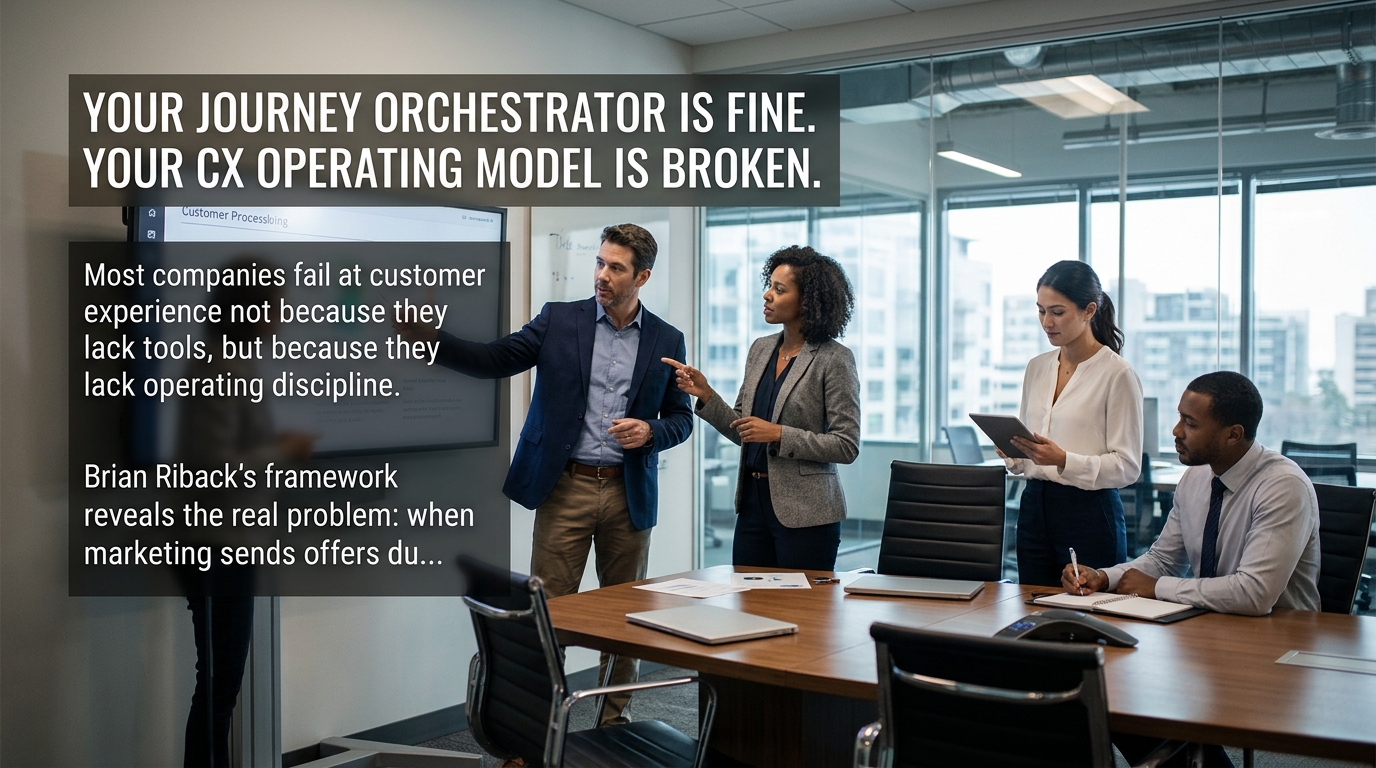
Most companies fail at customer experience not because they lack tools, but because they lack operating discipline. Brian Riback’s framework reveals the real problem: when marketing sends offers during service escalations while billing flags risk, no single team owns the decision. The solution isn’t another platform—it’s building a governed path from customer signals to coordinated enterprise action.
Key Points:
- Start with one financially material journey, establish shared signal definitions across departments, and write bright-line decision rules before implementing technology
- Assign clear RACI ownership (Responsible, Accountable, Consulted, Informed) for every decision point where customer signals trigger cross-functional action
- Measure daily reliability of signal capture, decision execution, and outcome delivery rather than campaign volume or feature adoption
Why it matters: Your attribution model can’t fix what your operating model breaks. When marketing, service, and billing operate on different signal definitions and decision rights, even perfect journey orchestration produces fragmented customer experiences. This 10-step framework transforms your existing tech stack from disconnected tools into a synchronized system by establishing governance first, automation second. The antidote to shiny-object syndrome starts here.
🔗 Q&A: Deloitte Digital exec on AI and customer personalization (4 minute read)

Deloitte Digital reveals a critical personalization paradox: 63% of consumers now start shopping with AI assistants rather than brand websites, yet nearly 9 in 10 brand leaders overestimate their personalization effectiveness while customers disagree. The gap? Brands focus on campaign volume rather than solving customer problems.
Key Points:
- Consumers spend 30% more with personalized brands but demand value—not targeting—expecting AI to anticipate needs (67%), save money (61%), and recognize loyalty (58%)
- By 2027, expect AI-mediated discovery, real-time decisioning, trust-by-design transparency, and earned loyalty to dominate retail strategy as top-of-funnel fundamentally shifts
- Retailers must shift from measuring outputs to building connected systems treating personalization as multiyear investments, not quarterly campaign tactics
Why it matters: You’re optimizing funnels consumers are abandoning. When 63% of shoppers start with AI assistants instead of your homepage, your entire acquisition model needs rethinking. The brands winning in 2027 won’t be those with the most personalization features—they’ll be those solving actual customer problems through connected systems that treat AI-mediated discovery as the new top-of-funnel reality. Stop measuring campaign volume and start building problem-solving infrastructure.
🔗 Thread AI’s Angela McNea: Full Automation Fails in Production Because the Hard Part Isn’t the Model (11 minute read)

Thread AI CEO Angela McNea challenges the myth that AI agents can automate enterprise decisions out-of-the-box. The real bottleneck isn’t model selection—it’s workflow design. Companies must predefine what constitutes “hard” problems, acceptable costs, and tolerable errors before deployment.
Key Points:
- McNea, a former Palantir engineer, advocates for “controlled autonomy”: agents operating within governed systems with human oversight injectable at any point, not full automation fantasies
- Her platform provides missing infrastructure primitives—identity, logging, isolation, governance—that enterprises currently rebuild repeatedly instead of focusing on business logic
- With stakes ranging from billions in banking reconciliation losses to life-or-death military deconfliction, codifying business logic determines success, not AI capability
Why it matters: The hard part of marketing automation isn’t the AI—it’s codifying your business logic, defining acceptable errors, and building governance. Before you deploy that AI agent to optimize email send times or personalize product recommendations, you need to predefine what constitutes a “hard” problem requiring human review, what error rates you’ll tolerate, and what costs justify intervention. McNea’s “controlled autonomy” framework pairs perfectly with the CX operating model story above: governance and workflow design come first, AI capability second.
🎯 Klaviyo Q3 Earnings Call Highlights
Klaviyo delivered 25% revenue growth reaching $387.2 million and a $1.5 billion annualized run rate, demonstrating that AI-powered email and SMS automation is moving from experimental to revenue-driving. Multi-product deals jumped to 43% of new revenue while Composer, their marketing AI agent, saw daily active accounts more than double to 10,000 within three weeks of launch. With 108% net revenue retention and 105 customers generating $500K+ annually (up 57% year-over-year), the data proves adaptive systems beat static automation when governance comes first. (Read more)
🎯 Beyond Customer Support: How CX Can Drive Engagement and Retention
Mindvalley’s Li Shin Tan reveals how customer support transcends ticket resolution to drive retention and product innovation. By leveraging AI for categorization and analysis, her team identifies patterns in customer conversations that signal churn risks and product gaps, with AI handling 55-60% of routine inquiries while freeing humans for complex judgment calls. The key insight: every support interaction is an early warning system for funnel leakage you’re not tracking. This transforms CX from cost center to strategic intelligence hub, showing how the retention stage of your customer journey contains signals your marketing team needs to see. (Read more)
🎯 Priority buys Fireberry to expand CRM automation
Priority Software acquired Fireberry CRM to unify customer and operational data within their cloud ERP system, promising marketers access to real-time business information for better campaign targeting and lifecycle messaging. The cautionary tale: the announcement lacks purchase price, integration timeline, and independent evidence of measurable customer outcomes. Before committing to integrated platforms promising unified customer views, demand demonstrations of actual cross-system workflows, data mapping protocols, and automation controls—not strategic vision slides. (Read more)
“The real bottleneck isn’t model selection—it’s workflow design. Companies must predefine what constitutes ‘hard’ problems, acceptable costs, and tolerable errors before deployment.”
— Angela McNea, CEO of Thread AI and former Palantir engineer
Which customer signal causes the most cross-functional chaos in your organization?
-
A) Support escalations happening during active marketing campaigns
-
C) Product usage drops that don’t trigger retention workflows
-
D) Sales marking leads as unqualified after marketing spent to acquire them
The through-line this week is clear: adaptive systems beat static automation, but only when governance and operating discipline come first. Deloitte showed us consumers are abandoning traditional funnels for AI assistants. Thread AI explained why full automation fails without workflow design. The CX operating model framework gave us the 10-step system to coordinate signals across departments. Mindvalley proved support interactions are early warning systems. Klaviyo’s earnings demonstrated that companies solving these problems see 25% growth and rapid AI adoption.
Your tech stack isn’t the problem. Your operating model is. Start with one financially material journey, establish shared signal definitions, write decision rules, assign RACI ownership, and measure daily reliability. Then let AI operate within those guardrails.
Until next time,
Funnel Marketing Systems Editor
📊 How did you like today’s email?
Originally published by Funnel Marketing Guy, your resource for funnel marketing, sales funnels, ClickFunnels, lead generation, conversion optimization, email marketing, marketing automation, and digital marketing strategies.
Continue your journey at https://www.funnelmarketingguy.com.
Enjoyed this issue?
Subscribe to get Funnel Marketing System delivered to your inbox every week.
Join 17 other subscribers • Free forever