
Revenue Engines: From CRO Control to Real-Time AI
How AI is reshaping the entire revenue org—not just the marketing stack
|
Welcome to Funnel Marketing System!
The funnel you built last year is already obsolete. AI agents, intent signals, and multi-entry-point journeys are rewriting the playbook—here’s what actually works now.
- 🎯 Why attribution just became a real-time budget engine, not a quarterly report
- 🔄 The CRO role evolution: from sales leader to full revenue-engine owner
- 🚪 Every page is now a landing page—how AI discovery killed the linear funnel
- 💎 Mining your CRM beats chasing new leads (and costs 80% less)
- ⚡ Intent signals replacing volume: the Buying Moments framework in action
The Measurement Revolution You’re Not Ready For
AI attribution isn’t a reporting upgrade anymore. It’s a decision engine that reallocates your budget mid-quarter without asking permission.
The shift requires three systems working as one: a CDP unifying customer records, a CRM receiving influence scores in real time, and marketing automation executing model-driven actions automatically. Most teams have pieces of this stack. Almost none have the integration or data governance to make it work.
The companies getting this right aren’t running better reports—they’re running different operations. When your attribution model can trigger a campaign, pause a channel, or shift $50K from paid social to paid search based on yesterday’s pipeline data, you’re no longer optimizing funnels. You’re operating a revenue machine that learns faster than your competitors can plan.
But this creates new risks. Automated decisions amplify bias. Privacy violations scale instantly. And when the model breaks, it breaks at budget velocity. Marketing ops leaders must evaluate platforms on integration capability and governance controls, not just prediction accuracy. The question isn’t whether AI attribution works—it’s whether your organization can handle what happens when it does.
🔗 AI marketing attribution is moving from quarterly scorecards to real-time budget calls (14 minute read)

AI marketing attribution is evolving from quarterly reporting tools into real-time decision engines that automatically reallocate budgets and trigger campaigns mid-quarter. This transformation requires three integrated systems working in concert: a customer data platform for unified customer records, a CRM to receive influence scores, and marketing automation to execute model-driven actions.
Key Points:
- Attribution has shifted from a reporting upgrade to a complex integration and data-governance project requiring CDP, CRM, and automation alignment
- Real-time attribution enables mid-quarter budget reallocation and automated campaign triggers based on live pipeline data
- Privacy, bias, and automated decision-making risks demand careful oversight—platforms must be evaluated on integration capability, not just prediction accuracy
Why it matters: When your attribution model can pause underperforming channels and shift budget automatically, you’re operating a revenue machine that learns faster than competitors can plan quarterly. But automated decisions amplify bias and scale privacy violations instantly. The companies winning this transition treat attribution as an operational transformation, not a software purchase—with governance controls built before the model goes live.
🔗 The chief revenue officer now runs the whole revenue engine (15 minute read)

The Chief Revenue Officer role has evolved from niche to strategic necessity, driven by digital customer journeys, exploding data volumes, and investor demands for sustainable revenue. Unlike traditional sales leadership, modern CROs own demand generation, sales, and post-sale expansion—consolidating fragmented marketing, sales, and service systems into one accountable function.
Key Points:
- CROs now own the entire revenue engine from demand gen through retention, not just sales execution
- The critical shift: prioritizing revenue quality over volume, as customers acquired incorrectly churn quickly
- Security vendors Evolv Technologies and Alcatraz AI exemplify this mandate, with CROs accountable for both contract closure and deployment success
Why it matters: This organizational restructuring addresses fundamental complexity in B2B go-to-market strategies and directly enables the integrated measurement systems discussed above. You can’t run real-time attribution across disconnected silos—someone must own the full funnel. The CRO evolution from sales leader to revenue-engine architect is what makes modern funnel optimization possible. When one executive owns CAC, conversion rates, and LTV simultaneously, you finally get the cross-functional accountability required to optimize for revenue quality instead of lead volume.
🔗 5 Questions That Redefine WordPress Lead Generation in 2026 (22 minute read)
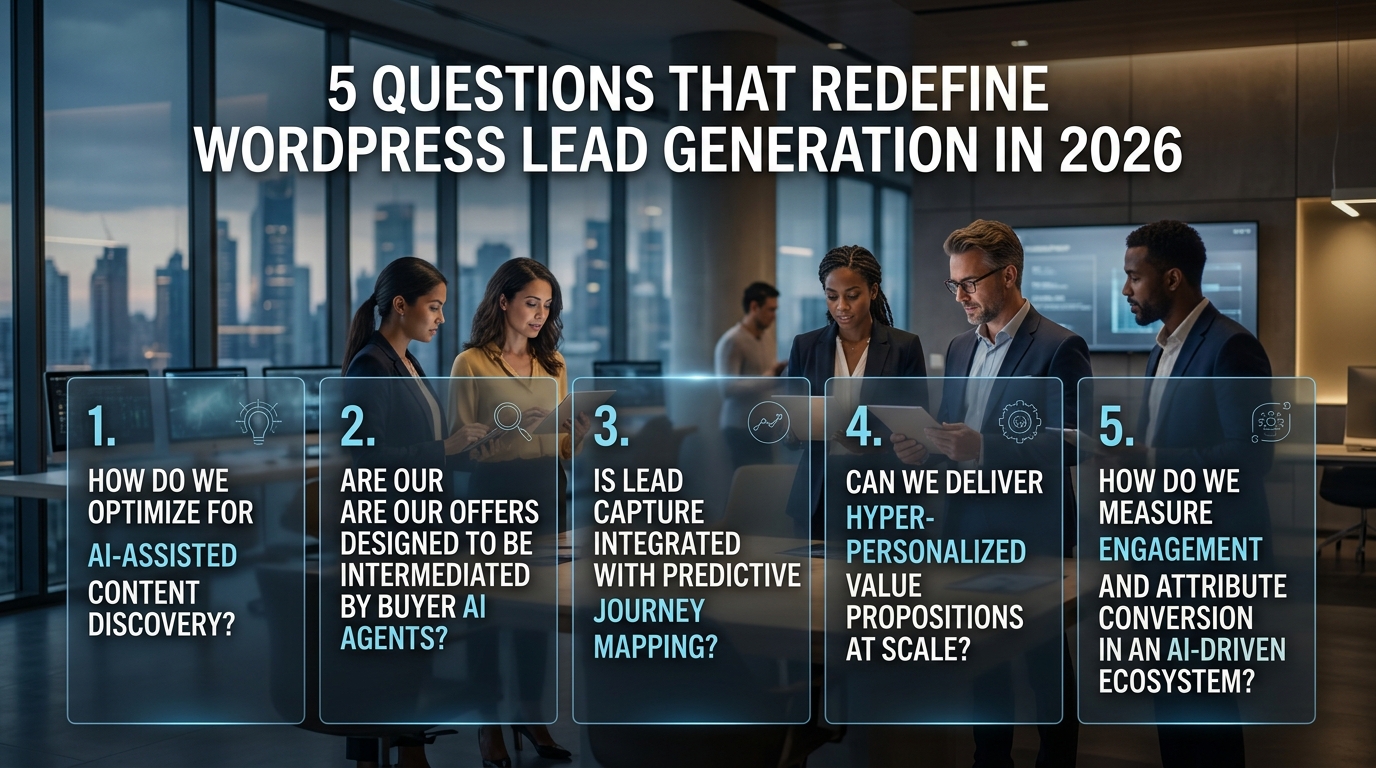
WordPress lead generation is fundamentally transforming as AI-assisted discovery reshapes buyer journeys. According to Gartner, 90% of B2B buying will be intermediated by AI agents by 2028, while 60% of consumers discover brands through social content and communities rather than traditional search. Visitors now enter via AI answers, LinkedIn posts, case studies, or pricing pages—not homepages.
Key Points:
- Businesses control less of the initial touchpoint—AI agents and social discovery replace traditional homepage-first journeys
- Every page must function as an independent decision environment with sufficient local context and clear next actions
- Rather than funneling visitors through one predefined sequence, sites must recognize and support buyer intent wherever it appears
Why it matters: The linear funnel is dead. When buyers enter through your pricing page after asking ChatGPT for vendor comparisons, your carefully crafted awareness-to-consideration sequence is irrelevant. This forces a fundamental rethink: treat every page as a potential first impression, equip it with enough context to orient any visitor, and provide multiple conversion paths based on intent signals. The winners in 2026 aren’t building better funnels—they’re building intent-aware conversion architectures that work regardless of entry point. (Read the full article)
🔗 Lead Qualified Revolutionizes B2B Sales Pipeline Generation with Targeted ‘Buying Moments’ Framework (4 minute read)

Lead Qualified launches its proprietary ‘Buying Moments’ framework targeting companies experiencing critical operational transitions—corporate relocations, downsizing, infrastructure expansions—intercepting them at peak decision-making moments. By combining real-time commercial intent data with multi-channel outreach, the company achieves a 300% higher call-to-meeting ratio than standard cold outreach and a 47% average appointment-to-pipeline conversion rate.
Key Points:
- Intent-based targeting using real-time operational transition signals (relocations, expansions, downsizing) rather than volume-based cold outreach
- 300% higher call-to-meeting ratio and 47% appointment-to-pipeline conversion by reaching decision-makers before RFPs are issued
- Approach proves especially effective for commercial moving, logistics, and workplace technology sectors where timing is critical
Why it matters: This is signal quality over volume in action. While most teams optimize for more leads, Lead Qualified optimizes for better moments—and the conversion metrics prove the difference. When you intercept buyers at operational inflection points rather than blasting contact lists, your qualification rates jump and your CAC drops. The framework demonstrates what intent-driven lead generation actually looks like: fewer conversations, higher conversion, shorter sales cycles. It’s the practical application of the trends discussed throughout this issue—and proof that timing beats volume every time.
“The next opportunity may already exist in your database—waiting for strategic rediscovery.”
— Rhino Precision Marketing, CRM Optimization Study
What’s your biggest funnel optimization priority right now?
- A) Improving attribution and measurement accuracy
- B) Optimizing for AI-driven discovery and multi-entry funnels
- C) Mining existing CRM data for forgotten opportunities
- D) Implementing intent-based targeting and lead scoring
The common thread across every story today: optimization is moving from “build a better funnel” to “build better signals and integrate them faster.” AI attribution shifts measurement from quarterly reviews to real-time budget engines. CROs consolidate fractured revenue functions into one accountable system. Multi-entry-point design replaces linear funnels as AI agents reshape discovery. And intent signals—whether operational transitions or CRM inactivity patterns—replace volume-based lead generation.
The companies pulling ahead aren’t running more campaigns or adding more automation. They’re running tighter integration between CDP, CRM, and execution layers. They’re mining existing data before chasing new leads. And they’re designing for intent recognition at every entry point rather than forcing visitors through predefined sequences. The funnel you built last year assumed control you no longer have—the one you build this quarter must work regardless of where buyers enter or how AI agents intermediate their journey.
Keep optimizing,
Funnel Marketing Systems Editor
📊 How did you like today’s email?
Originally published by Funnel Marketing Guy, your resource for funnel marketing, sales funnels, ClickFunnels, lead generation, conversion optimization, email marketing, marketing automation, and digital marketing strategies.
Continue your journey at https://www.funnelmarketingguy.com.
Enjoyed this issue?
Subscribe to get Funnel Marketing System delivered to your inbox every week.
Join 17 other subscribers • Free forever