
ChatGPT Ads Just Got Smarter (And Your ROI Did Too)
Track every ChatGPT ad click to conversion—finally know what's working
|
Welcome to Funnel Marketing System!
Payment friction just became the most expensive conversion leak you’re not tracking—and the fix isn’t technical, it’s operational.
- 🔧 Why payment processing is costing you 6x more revenue than you think
- 🎯 The attribution breakthrough that makes AI ad channels finally measurable
- 📊 How privacy enforcement is rewiring lead capture and funnel tracking
The Hidden Conversion Stage You’re Ignoring
Your funnel doesn’t end at “Add to Cart.”
It ends when money moves—and that’s where most operators stop paying attention. Payment processing gets treated as infrastructure, not conversion optimization. But new data shows firms with recurring payment friction lose 1.92% of annual revenue versus just 0.31% for friction-light operations. That’s a 6x difference driven entirely by operational bottlenecks at checkout.
The pattern is clear: companies facing high business uncertainty report payment friction at 6x the rate of stable firms. Security delays compound. Customer retention craters. And the entire conversion funnel—no matter how optimized upstream—bleeds out at the finish line.
The fix isn’t adding more payment options. It’s automation that eliminates the speed-versus-security trade-off entirely.
🔗 Closing the Payment Gap: New Data on Speed, Risk and Retention (8 minute read)
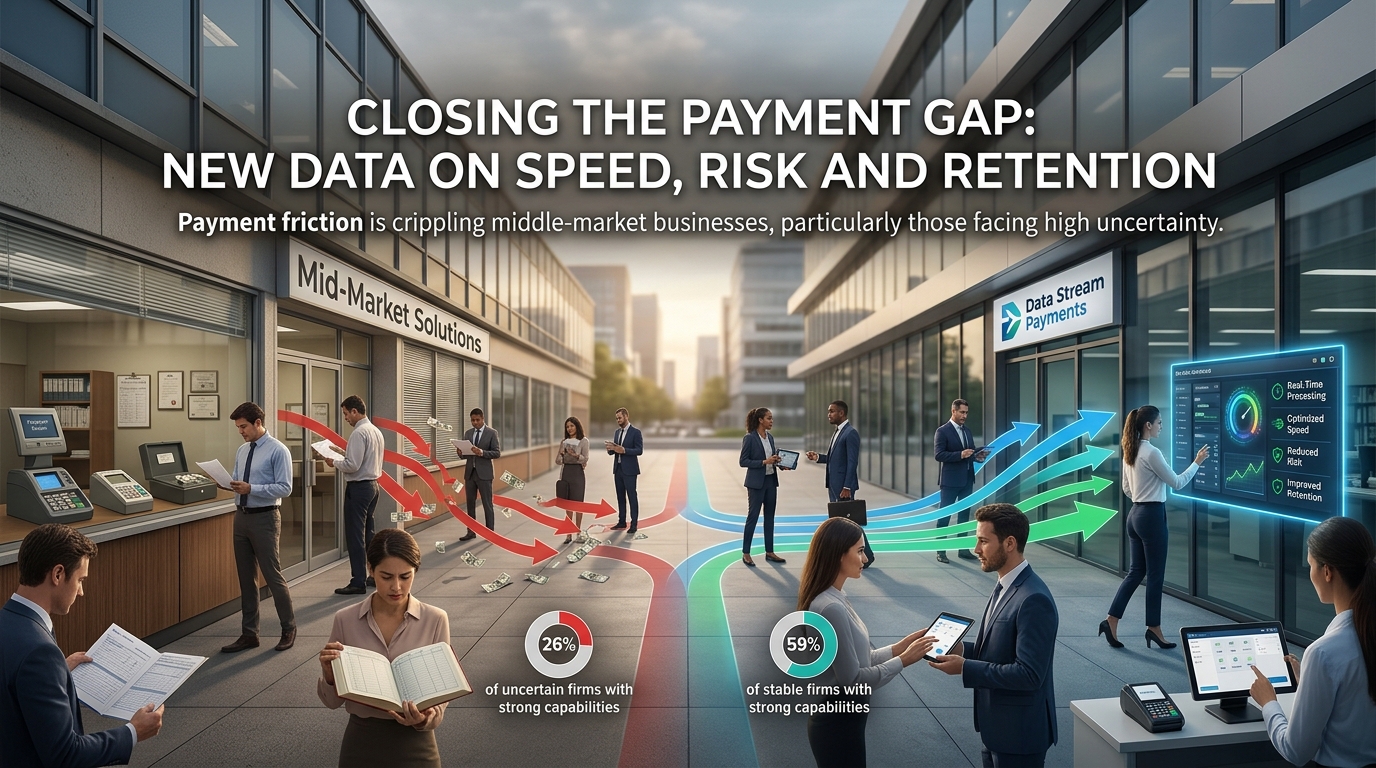
Payment friction is crippling middle-market businesses, particularly those facing high uncertainty. Only 26% of uncertain firms report strong payment processing capabilities versus 59% of stable firms, and the revenue impact is quantifiable and severe.
Key Points:
- Firms with recurring payment friction lose 1.92% of annual revenue compared to 0.31% for friction-light operations—a 6x difference
- Over half of uncertain firms experience security-related payment delays, with recurring friction 6x more common than in stable companies
- Customer retention risks skyrocket: 44% of recurring-friction firms cite payment reliability as critical to retention versus just 4% of friction-light firms
- 89% of affected companies want automated end-to-end payment processing to simultaneously improve speed and security
Why it matters: Payment processing is a conversion stage, not just infrastructure. Every second of delay, every security hold, every manual review step introduces friction that kills deals and erodes retention. The 6x revenue difference between friction-light and friction-heavy operations proves that checkout optimization isn’t a technical problem—it’s a systematic operational advantage. Automation doesn’t just speed things up; it eliminates the false choice between speed and security that causes most payment bottlenecks. (Read more)
🔗 CTM brings closed-loop attribution to ChatGPT advertising with native OpenAI Ads integration (9 minute read)

CTM became the first call-tracking provider to enable closed-loop attribution for ChatGPT advertising campaigns, solving a critical measurement gap for performance marketers running AI-powered ads. The integration allows marketers to track phone conversions from ChatGPT ads and send conversion data back to OpenAI for bid optimization.
Key Points:
- Native OpenAI Ads integration enables phone conversion tracking from ChatGPT advertising campaigns—the first solution to close the attribution loop for AI ad channels
- Conversion data flows back to OpenAI for bid optimization, treating AI channels like any other performance channel
- CTM simultaneously released AskCTM, an in-platform AI agent that democratizes advanced AI features for non-technical teams
- Addresses enterprise demand for accountability in AI ad spending, particularly in high-intent verticals like legal and home services where phone calls drive conversions
Why it matters: ChatGPT ads just became measurable. Until now, AI discovery channels existed in an attribution black hole—you could run ads, but you couldn’t track conversions or optimize bids based on actual outcomes. CTM’s integration solves the missing link between AI traffic and funnel ROI. For verticals where phone calls convert, this turns AI channels from experimental budget into a trackable, optimizable performance channel with the same rigor as search or social. (Read more)
🔗 THE FUTURE OF ADS PERSONALIZATION: Targeting Efficiency in an Age of Consent Signals and Cookie Reversals (22 minute read)

Google’s decision to keep third-party cookies alive in Chrome surprised the industry, but the real story is regulatory, not technical. While cookies survived, the enforcement landscape transformed dramatically—and it’s now testing actual data flows, not just privacy policies.
Key Points:
- Twenty-one U.S. states now have comprehensive privacy laws, and enforcement has shifted from reading privacy policies to testing actual data flows and wire-level compliance
- The Global Privacy Control (GPC), a browser-transmitted opt-out signal, is now legally binding in twelve states—regulators are catching companies that display privacy banners while still streaming identifiers to advertisers
- Lead generation and data brokerage businesses face the greatest challenge as regulators move from paper compliance to testing what data actually moves across the wire
- The enforcement turn poses immediate risks for marketing automation, consent flows, and attribution systems that haven’t audited their data streams for GPC compliance
Why it matters: Privacy compliance just became a funnel infrastructure problem. The shift from policy compliance to wire-level enforcement means your consent flows, tracking pixels, and lead capture forms are now the compliance surface area regulators are testing. If your automation stack streams identifiers to advertisers while displaying a privacy banner, you’re exposed. For marketers running lead gen funnels across multiple states, this requires auditing every data handoff—from form submission to CRM to retargeting—to ensure GPC signals are honored at every step. (Read more)
“The goal is to turn data into information, and information into insight.”
— Carly Fiorina, Former CEO of Hewlett-Packard
What’s the biggest conversion bottleneck in your funnel right now?
- A) Checkout and payment friction
- B) Attribution and tracking gaps
- C) Privacy compliance and consent flows
- D) Lead quality and qualification
The pattern across today’s stories is clear: operational friction at critical conversion stages costs more than you think, and the fix is systematic automation that eliminates false trade-offs. Payment processing isn’t just infrastructure—it’s a conversion stage where friction costs 6x more revenue than optimized operations. AI ad channels aren’t unmeasurable—they just needed closed-loop attribution to become accountable. Privacy compliance isn’t a legal checkbox—it’s a funnel infrastructure audit that tests every data handoff.
The operators winning right now aren’t adding more tools. They’re identifying the operational bottlenecks that kill conversions after prospects are already engaged, then automating the friction out of existence.
Keep optimizing,
Funnel Marketing Systems Editor
📊 How did you like today’s email?
Originally published by Funnel Marketing Guy, your resource for funnel marketing, sales funnels, ClickFunnels, lead generation, conversion optimization, email marketing, marketing automation, and digital marketing strategies.
Continue your journey at https://www.funnelmarketingguy.com.
Enjoyed this issue?
Subscribe to get Funnel Marketing System delivered to your inbox every week.
Join 17 other subscribers • Free forever