
Autonomous CX is Here: Your Funnel Just Got Smarter
AI-powered personalization at scale—plus the agencies making it happen
|
Welcome to Funnel Marketing System!
Enterprise AI agents are now running your competitors’ campaigns while you sleep. The question isn’t whether to deploy them—it’s who approves what they create.
- 🤖 SAP launches autonomous agents that qualify deals, resolve cases, and execute campaigns without human intervention
- 🎯 Why unified customer data just became worth $5.66 billion to Salesforce
- 🔍 GEO strategies: if AI shopping assistants can’t parse your product pages, you’re invisible regardless of funnel sophistication
The Governance Gap Nobody’s Talking About
SAP’s Q3 2026 announcement isn’t another AI feature release. It’s the moment enterprise platforms crossed from intelligent recommendations into autonomous execution. Deal Qualification Assistants now score leads and update CRMs. Case Management Assistants resolve support tickets end-to-end. Campaign Assistants orchestrate multi-channel marketing without waiting for approval.
The capability is live. The governance model is not.
You’re facing the same tension every marketing leader confronts right now: AI agents can execute faster than any human team, but speed without oversight creates brand risk, budget overruns, and compliance nightmares. The companies winning this transition aren’t choosing between automation and control—they’re building systems that deliver both.
This issue breaks down what’s working. You’ll see how ThinkingStreams handles the approval workflow, why Salesforce paid premium for unified customer data, when Zoom’s AI preserves context versus when Smith.ai deploys humans, and how GEO strategies determine whether AI shopping assistants ever surface your products. Every insight connects to one question: how do you scale AI-assisted execution without losing the human judgment that drives conversion?
🔗 Autonomous CX Arrives: What’s New in SAP Customer Experience Q3 2026 (6 minute read)
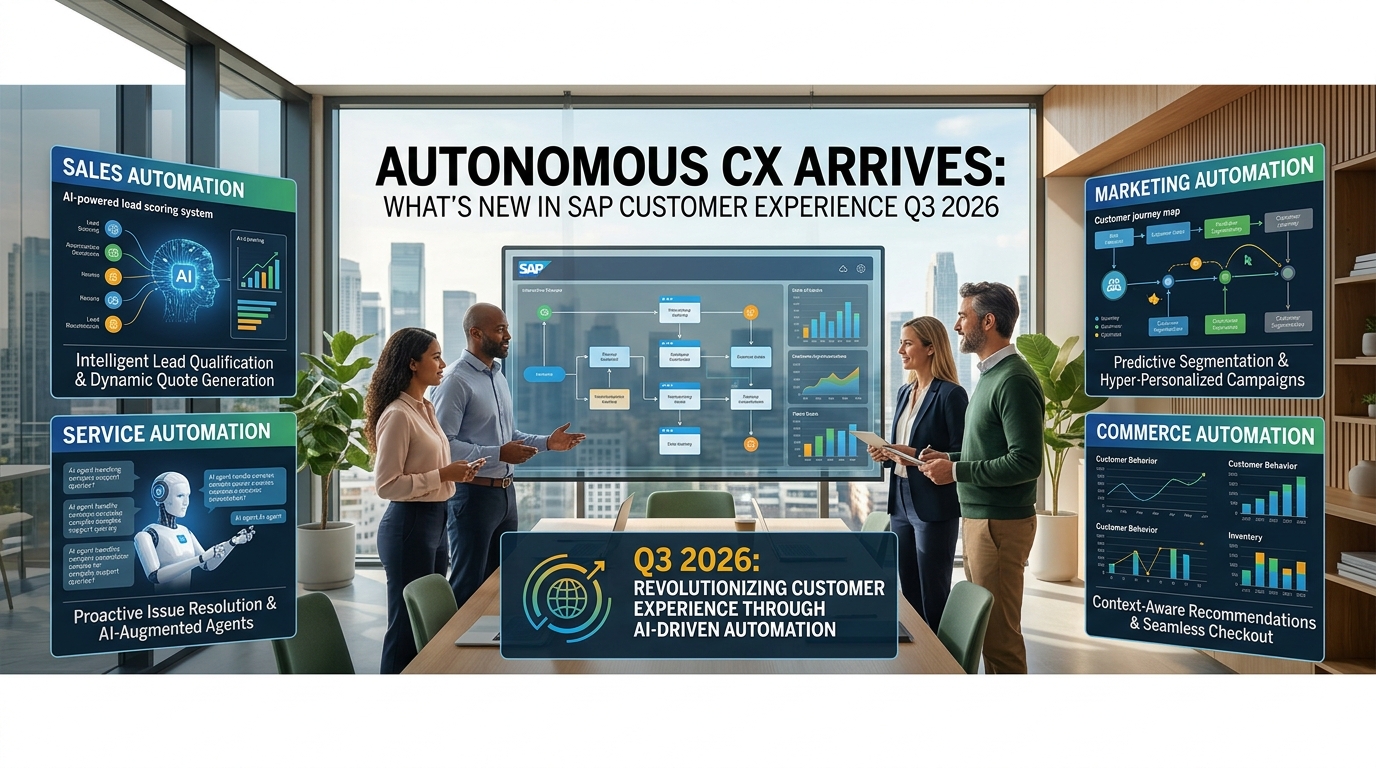
SAP’s Q3 2026 release moves AI from content generation into full funnel orchestration. The platform now deploys specialized agents that qualify deals, manage support cases, and execute marketing campaigns—autonomously coordinating work across the entire customer journey while connecting to backend ERP and business process systems.
Key Points:
- Deal Qualification Assistants automatically score leads, update CRM records, and route opportunities based on fit and intent signals
- Case Management Agents resolve customer service issues end-to-end, from initial contact through backend system coordination to final resolution
- Campaign Assistants orchestrate multi-channel marketing execution, managing audience segmentation, content deployment, and performance optimization without manual intervention
- Unified commerce capabilities connect customer demand signals directly to retail operations and inventory systems for real-time fulfillment
Why it matters: This is the inflection point where enterprise platforms stop assisting marketers and start executing independently. The capability shift is clear—agents now handle tasks that previously required human decision-making at every step. But SAP’s release exposes the governance challenge nobody’s solved: who approves what when an AI agent can launch a campaign at 2 AM? How do you maintain brand safety, budget controls, and compliance when execution speed outpaces human review cycles? The companies that figure out approval workflows, cost guardrails, and audit trails will capture the efficiency gains. Everyone else gets speed without control—which is just expensive chaos. (Read more)
🔗 Marketing automation veterans reveal ThinkingStreams, a new agentic solution (3 minute read)
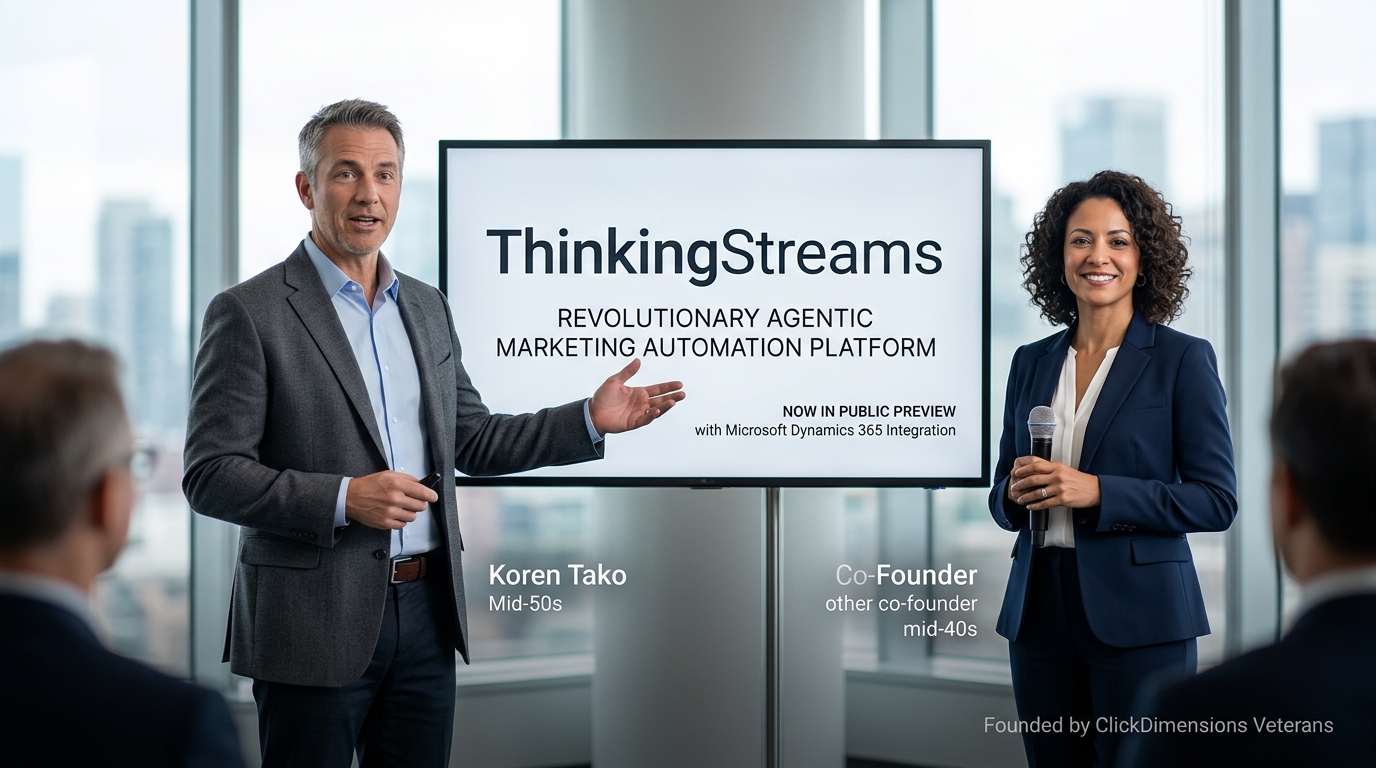
ClickDimensions founders Koren Tako and Brad Burks just launched ThinkingStreams, a B2B marketing automation platform that solves the approval problem SAP’s announcement created. AI agents handle campaign planning, copywriting, email creation, landing page design, and nurture journey construction—but nothing executes without mandatory human approval.
Key Points:
- AI agents create full marketing campaigns including copy, emails, landing pages, and multi-touch nurture sequences based on objectives and audience parameters
- Mandatory human approval workflow ensures marketers review and authorize all AI-generated content before deployment
- Platform centralizes previously scattered workflows (campaign planning, content creation, deployment, measurement) into one system with Microsoft Dynamics 365 integration
- Founded by marketing automation veterans who built and sold ClickDimensions, bringing credibility and practical operator experience to the governance challenge
Why it matters: ThinkingStreams represents the middle path between full automation and manual execution—the model most marketing teams will actually adopt. SAP showed what’s possible when agents run autonomously. ThinkingStreams shows what’s practical when you need speed without sacrificing oversight. The mandatory approval workflow isn’t a limitation—it’s the feature. You get AI’s speed on creation (campaigns that took days now take hours) while maintaining human judgment on brand voice, offer strategy, and audience targeting. This is the governance framework others should copy: agents create, humans approve, systems execute. Public preview is live now with general availability planned for January 2027. (Read more)
🔗 Salesforce to acquire marketing automation provider Braze for $5.66B (6 minute read)

Salesforce is paying $5.66 billion for Braze—a 58% premium over market value—to acquire unified customer data infrastructure and cross-channel personalization capabilities. Braze aggregates customer behavior across touchpoints using 190+ connectors, then enables personalized marketing campaigns across email, mobile, web, and messaging channels.
Key Points:
- $5.66B acquisition price represents 58% premium, validating that unified customer data and cross-channel orchestration are now table-stakes capabilities worth premium valuations
- Braze’s 190+ connectors centralize customer data from CRM, commerce, support, product usage, and behavioral sources into one actionable repository
- BrazeAI automatically generates campaign materials while Agentic Standards create guardrails for AI-generated content—the same governance challenge ThinkingStreams addresses
- Revenue grew 26% year-over-year to $227.2M last quarter, demonstrating strong market demand for behavior-based marketing automation
Why it matters: Salesforce just paid a 58% premium to acquire what AI agents need most: unified customer data and cross-channel execution infrastructure. You can’t personalize at scale without consolidated customer history. You can’t measure incrementality without understanding the full journey. You can’t deploy AI agents effectively when customer data lives in seventeen disconnected systems. Braze’s 190+ connectors solve the integration problem that makes AI-assisted funnels possible. The acquisition validates what operators already know: the competitive advantage isn’t having AI agents—it’s having the data infrastructure that makes them effective. If your customer data is fragmented across platforms, AI agents just automate confusion faster. (Read more)
“The fastest-growing commerce platforms succeed precisely because they prioritize human-centric experiences. In an AI-driven discovery landscape, personal connection isn’t nostalgic luxury; it’s essential for survival.”
— Matt Waksman, Strategy Director at Droga5 London
🎯 Customer history shouldn’t end with the call: Zoom CX at Zoomtopia 2026
Zoom’s CX platform demonstrates when automation preserves value versus when humans are essential. The key insight: customers hate repeating themselves across channels. Zoom’s unified context orchestrates conversations across voice, chat, video, and email—so a photographer getting a damaged lens replaced doesn’t restart the conversation when escalating from chatbot to live agent. Success is now measured by resolution rates and customer effort, not interaction volume. The shift from measuring activity to measuring outcomes mirrors the broader funnel evolution from tracking MQLs to tracking revenue. (Read more)
🎯 Smith.ai Names Suresh Khanna CEO, Expands Executive Team to Accelerate Growth in Legal Intake
Smith.ai’s leadership expansion validates a critical principle: high-value, complex sales require immediate human engagement after AI qualification. The company combines 500+ live agents with AI efficiency to handle legal intake—treating it as a revenue engine rather than administrative task. New CEO Suresh Khanna (former Google and AdRoll executive) and CPO Anthony Emmanuel Medina (who built Apollo.io’s $1.6B sales platform) bring credibility to the hybrid model. The lesson for your funnel: AI can qualify and route, but conversion on complex offerings still requires humans at the right moment. (Read more)
🎯 CRM Vendors Tackle AI Costs and Customer Data Access
The reality check nobody wants to discuss: AI agents need guardrails, budget controls, and proper data access. HubSpot introduced flexible pricing with AI spend caps and seat-to-credit exchanges to address cost concerns. Salesforce partnered with Demandbase to equip its Hunter sales agent with real-time buying signals. Adobe enhanced Customer Journey Analytics with conversation insights and added read-only MCP permissions for data governance. These moves reflect industry pressure to make customer data operational while managing complexity, integration challenges, and ensuring measurable ROI. The shift from “does it work?” to “can we afford it and control it?” is happening now. (Read more)
🎯 How TagStride Limited Aligns Testing Roadmaps With Campaigns
Most testing programs generate data without direction—experiments that don’t inform decisions. TagStride’s five-step framework connects AB testing to campaign objectives from the start: begin with campaign goals rather than hypotheses, sequence tests to build on prior results, align test cadence to decision timelines, integrate results into campaign reviews, and track learning accumulation. HubSpot’s 2024 report found marketing teams with documented strategies are 313% more likely to report success. Treat testing as part of campaign management, not separate activity, and you get compounding improvements instead of isolated data points. (Read more)
🎯 Best GEO Agencies for Ecommerce Brands in 2026
AI shopping assistants drove 393% year-over-year traffic growth, but product pages average only 66% machine-readability. If ChatGPT, Perplexity, Claude, and Gemini can’t understand your product content, you’re invisible regardless of downstream funnel sophistication. Generative engine optimization (GEO) differs from traditional SEO by optimizing how brands appear in AI-generated recommendations, not just search rankings. Success requires shopper research, technical product-content improvements, third-party publisher strategies, and measurable outcomes. The article compares six leading GEO agencies helping ecommerce brands enter AI consideration sets. (Read more)
🎯 From SEO to AI-Driven Search: Strategies for E-commerce Brands to Maintain Visibility
Don’t abandon SEO—enhance it while ensuring AI systems can parse your product information. The key strategy: create comprehensive, customer-focused content that answers real questions buyers ask before purchasing, not just listing specs. Technical SEO, structured data, consistent business information across platforms, and supplementary guides remain essential. Success requires measuring actual business outcomes like conversions and revenue, not just visibility metrics. The shift from specs to answers mirrors the broader funnel evolution from broadcasting to intent-based nurturing. (Read more)
What’s your biggest AI agent concern right now?
- A) Cost management and budget controls
- B) Approval workflows and governance
- C) Data integration and unified customer view
- D) Measuring incrementality and ROI
The shift from AI-assisted to AI-operated funnels is happening faster than most marketing teams can adapt. SAP’s autonomous agents, ThinkingStreams’ approval workflows, and Salesforce’s $5.66B bet on unified data represent three pieces of the same puzzle: execution speed is now available to everyone, but governance, data infrastructure, and strategic judgment separate winners from expensive chaos.
The next six months will separate teams that deploy AI agents thoughtfully from teams that just automate existing dysfunction faster. Focus on three things: build approval workflows before you need them, consolidate customer data so agents have context, and optimize for AI discovery at the top of your funnel. Speed without control burns budget. Control without speed loses market share. The balance is where competitive advantage lives.
For more funnel frameworks and conversion strategies, visit https://www.funnelmarketingguy.com.
Until next time,
Funnel Marketing Systems Editor
📊 How did you like today’s email?
Originally published by Funnel Marketing Guy, your resource for funnel marketing, sales funnels, ClickFunnels, lead generation, conversion optimization, email marketing, marketing automation, and digital marketing strategies.
Continue your journey at https://www.funnelmarketingguy.com.
Enjoyed this issue?
Subscribe to get Funnel Marketing System delivered to your inbox every week.
Join 17 other subscribers • Free forever