
AI Just Shortened Your Customer Journey—Here's How
When AI does the research, your funnel needs to adapt fast
|
Welcome to Funnel Marketing System!
The funnel isn’t dying—it’s evolving into something faster, smarter, and harder to measure. Here’s what’s changing and what you need to fix first.
- 🤖 AI agents are compressing customer journeys, but speed alone won’t win
- 📊 Why 54% of marketers can’t trust their conversion data (and what to do about it)
- 🔧 Stack consolidation is accelerating—unified profiles beat fragmented tools
- 💰 Real numbers: 310% more signups, 75% lower cost per conversion
- 🎯 From campaign launches to lifecycle orchestration
The Funnel Is Becoming an AI-Mediated Revenue System
AI is no longer sitting outside your funnel optimizing ad delivery. It’s moving inside—handling search discovery, product recommendations, checkout assistance, and post-purchase engagement. The shift is structural, not incremental.
Google is expanding ads into AI Mode follow-up questions. Amazon’s Ads Agent automates campaign management across sponsored, display, video, and streaming. Shopify merchants can now describe an upsell funnel in plain English and watch AI build the entire sequence.
The winners in this environment won’t be the fastest. They’ll be the ones who measure accurately, orchestrate across lifecycle stages, and optimize for customer value instead of vanity metrics.
Three things matter more now than they did six months ago: clean conversion data you can actually trust, unified customer profiles that work across channels, and the discipline to optimize for revenue per customer instead of cost per click.
Most marketing teams are failing at all three. The data below shows what’s working for the ones who aren’t.
🔗 How To Create Customer Value As AI Shrinks The Customer Journey (5 minute read)

As AI accelerates customer journeys from discovery to purchase, speed becomes table stakes—not a competitive advantage. Jerry Haywood argues that companies must shift from transaction-focused efficiency to relationship-building value creation. The counterintuitive insight: use AI to eliminate low-value interactions so you can invest in the emotional moments that actually drive loyalty and lifetime value.
Key Points:
- Speed is now a baseline expectation, not differentiation—customers expect frictionless experiences but don’t reward them with loyalty
- AI should handle routine, low-value interactions to free resources for personalized assistance at high-stakes moments
- Use data from compressed journeys to identify where contextual, proactive support transforms brief transactions into deeper relationships
Why it matters: Every platform is racing to compress your funnel with AI agents. But if you’re only optimizing for speed, you’re commoditizing yourself. The real opportunity is using AI to eliminate friction in low-value moments—order tracking, basic FAQs, product specs—so you can invest in the touchpoints that genuinely strengthen customer lifetime value. This is the strategic framework for thinking about agentic commerce: automate the transactional, personalize the emotional.
🔗 Flipsnack grows product signups with conversion optimization (4 minute read)
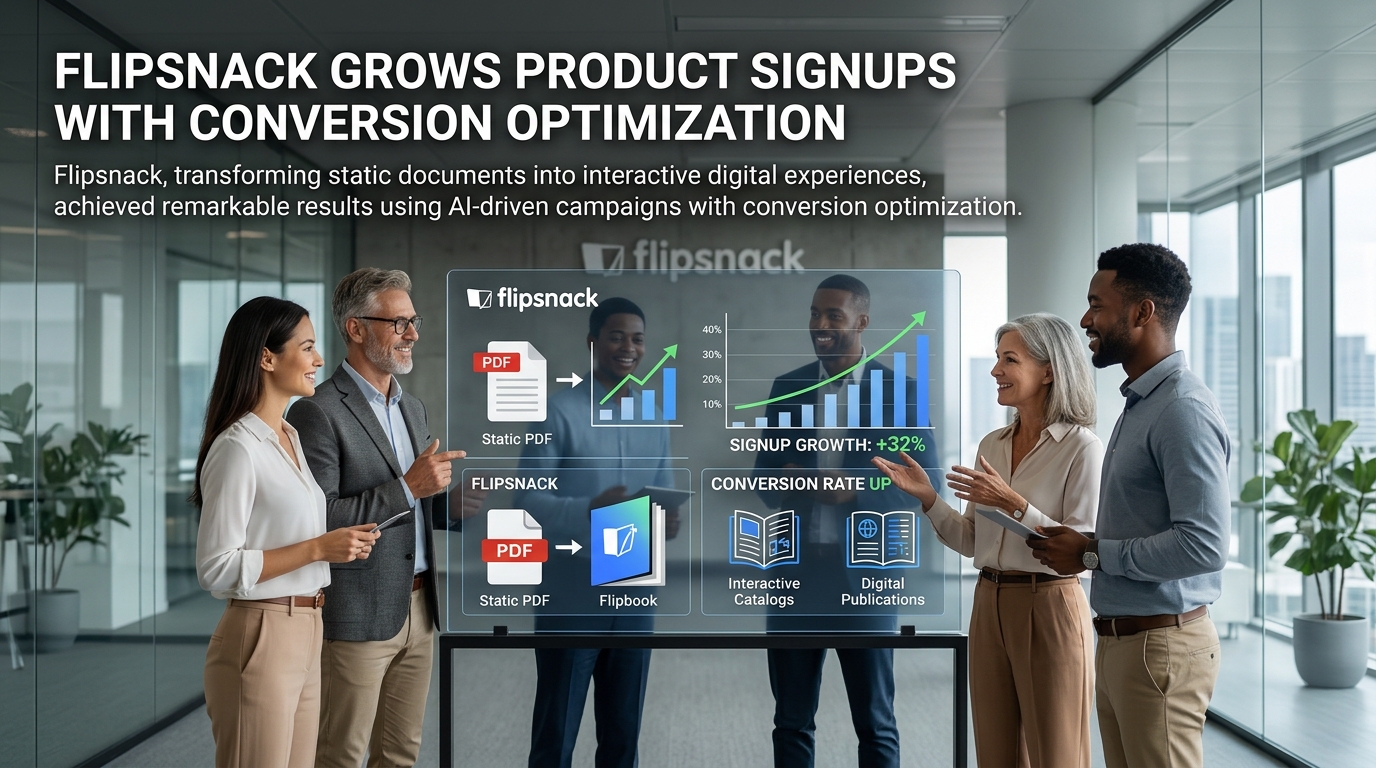
Flipsnack transformed static documents into interactive digital experiences—and their advertising from wasteful to ruthlessly efficient. By shifting from click-focused to conversion-focused campaigns in ChatGPT Ads, they increased product registrations by approximately 310% while slashing cost per signup by 75%. The strategy wasn’t creative genius; it was aligning ad objectives with actual business outcomes.
Key Points:
- Conversion-focused campaigns delivered 310% more product signups compared to click-optimization approach
- Cost per signup dropped 75% by optimizing for meaningful user actions instead of traffic volume
- Segmented campaigns by use case (Magazine, Catalog, Brochure, Sales Enablement) helped diverse customers recognize product fit
Why it matters: This is the measurement imperative in action. Most platforms default to optimizing for clicks or impressions because those metrics are easy to measure and look good in reports. But Flipsnack’s results prove what happens when you optimize for what actually matters—conversions that drive revenue. The 4x efficiency gain isn’t from better creative or audience targeting. It’s from telling the algorithm to optimize for signups instead of clicks. If you’re still running click-optimized campaigns, you’re leaving 75% of your efficiency on the table.
🔗 Rethinking DX in the age of agentic AI: Reply is among the market leaders (6 minute read)

AI agents are revolutionizing digital experience design, with 48% of B2B and 63% of B2C companies prioritizing them strategically according to the latest Lünendonk study. Organizations are investing heavily—79% plan increased DX spending, two-thirds are modernizing data landscapes, and 60% are expanding AI expertise. But the infrastructure requirements are specific and non-negotiable.
Key Points:
- Three critical trends: optimizing visibility for AI search, leveraging conversational agents for personalized product advisory, and scaling smart content production
- Success requires clean data architectures, structured content, and secure APIs enabling seamless human-AI interactions across all touchpoints
- Companies need integrated capabilities spanning strategic consulting, creative design, data engineering, and technical implementation to create AI-ready customer journeys
Why it matters: This is the infrastructure play that makes everything else work. You can’t optimize for AI search if your product data is unstructured. You can’t deploy conversational agents if your APIs aren’t secure and accessible. You can’t scale content production if your data landscape is fragmented. The companies winning with agentic AI aren’t the ones with the best creative—they’re the ones who built clean data architectures and structured content systems before AI agents became table stakes. If you’re planning to “add AI” to your funnel without fixing your data infrastructure first, you’re building on sand.
“The funnel is evolving from fixed page sequences to adaptive, AI-mediated revenue systems—and the winners will be those who measure accurately, orchestrate across lifecycle stages, and optimize for customer value.”
— Funnel Marketing Systems Editor
🎯 Zipify OneClickUpsell Now Integrates With Shopify Sidekick
Zipify launched the first upsell app integration with Shopify Sidekick, letting merchants build entire upsell funnels by describing what they want in plain English. The AI recommends trigger products, upsell products, funnel names, and discounts based on store data. This is agentic commerce moving from theory to Shopify admin—AI doesn’t just optimize your funnel, it builds it. (Read more)
🎯 WPBeginner Growth Fund buys Drip and Sleeknote to build small-business marketing suite
WPBeginner Growth Fund acquired Drip (serving 6,000+ brands with $1.5B in attributed revenue) and Sleeknote to create an integrated marketing suite unifying email, SMS, and website conversion data. It’s the same consolidation playbook larger players like Salesforce are running: fragmented tools are giving way to unified customer profiles and cross-channel orchestration. Both platforms will operate independently with no immediate service changes. (Read more)
🎯 7 Key Marketing KPIs to Track & How to Measure Them
Harvard Business School’s breakdown of essential marketing KPIs reveals the measurement crisis: 54% of marketers lack confidence in their data accuracy. The guide covers funnel-stage metrics across awareness (impressions, search rankings), consideration (CTR, CPC), and decision (conversion rate, CAC). The foundational insight: metrics are any data point, but KPIs are metrics tied to business objectives. If you can’t trust your numbers, you can’t optimize your funnel—and most teams can’t trust their numbers. (Read more)
🎯 Amazon emerges as digital advertising powerhouse rivaling Alphabet and Meta
Amazon’s advertising revenue grew 12% year-over-year in Q3 2026 with high-teens growth expected ahead. The platform’s advantage is direct access to purchase-ready shoppers, amplified by AI-powered Ads Agent automating campaign management and Full-Funnel Campaigns unifying sponsored, display, video, and streaming ads. Prime Video and Thursday Night Football expand reach beyond e-commerce. This is what full-funnel automation looks like at platform scale—AI managing creative, targeting, and orchestration across every touchpoint. (Read more)
What’s your biggest funnel challenge right now?
- A) Measurement accuracy and conversion tracking
- B) Marketing stack consolidation and data unification
- C) Lifecycle optimization beyond one-off campaigns
- D) Adapting to AI-driven customer journeys
The funnel isn’t disappearing. It’s compressing, accelerating, and becoming AI-mediated at every stage. But the fundamentals haven’t changed—you still need clean data, unified customer profiles, and the discipline to optimize for revenue instead of vanity metrics.
The teams winning right now are the ones who fixed their measurement infrastructure before AI platforms changed how conversions are counted. They’re the ones who consolidated fragmented tools into unified orchestration systems before agentic commerce became table stakes. And they’re the ones optimizing for customer lifetime value while everyone else chases cost per click.
If you’re still running click-optimized campaigns, operating with fragmented customer data, or trusting platform-reported conversions without first-party validation, you’re already behind. The good news: the playbook is clear, the tools exist, and the results are measurable.
Keep building,
Funnel Marketing Systems Editor
📊 How did you like today’s email?
Originally published by Funnel Marketing Guy, your resource for funnel marketing, sales funnels, ClickFunnels, lead generation, conversion optimization, email marketing, marketing automation, and digital marketing strategies.
Continue your journey at https://www.funnelmarketingguy.com.
Enjoyed this issue?
Subscribe to get Funnel Marketing System delivered to your inbox every week.
Join 17 other subscribers • Free forever