
AI Just Changed How You Convert Browsers to Buyers
The tools and tactics that are actually working right now (not theory)
|
Welcome to Funnel Marketing System!
Your funnel isn’t broken because you lack features—it’s broken because you’re still building manually while AI-powered competitors automate the entire journey from first click to closed deal.
- 🤖 How AI is rebuilding B2B lead generation from prospecting through personalization
- 🔧 The CRO stack shift: from manual A/B testing to autonomous optimization
- 📊 Trust signals as measurable funnel variables, not brand exercises
- 🏋️ Why vertical-specific funnel automation is becoming an M&A category
- 🔄 The customer expectation reset forcing complete funnel rethinking
The AI Funnel Infrastructure Shift
Your competitors aren’t just using better tools—they’re running entirely different systems. While you’re manually segmenting email lists and scheduling A/B tests, AI-powered platforms are identifying high-intent prospects in real time, personalizing outreach across channels, and autonomously optimizing conversion paths without human intervention.
This isn’t incremental improvement. It’s categorical advantage. The B2B lead generation stack is being rebuilt around signal-based prospecting and real-time personalization. The CRO toolkit is shifting from manual testing disciplines to machine learning systems that optimize continuously. And customer expectations are resetting faster than most funnels can adapt.
The evidence is in the acquisitions, the tool capabilities, and the performance gaps. Companies running AI-powered funnel infrastructure are seeing 3-5x higher reply rates, measurable conversion lift without adding headcount, and complete lead-to-booking automation in vertical markets. The question isn’t whether to adopt these systems—it’s whether you’ll do it before your pipeline dries up.
🔗 Top 10 AI Tools for Lead Generation in 2026: Scale Your B2B Sales Pipeline (13 minute read)

The B2B lead generation stack is being rebuilt around AI-powered signals and real-time personalization. Traditional cold calling and mass email are obsolete—modern buyers demand hyper-personalized interactions based on actual intent signals, not demographic guesses. This comprehensive breakdown covers the 10 platforms transforming outbound sales in 2026, from data enrichment through automated multichannel outreach.
Key Points:
- Clay excels at data enrichment, Apollo.io offers all-in-one affordability at scale, while Agent Jesse pioneers real-time signal-based prospecting that triggers outreach based on buyer behavior
- Warmly captures warm intent from website visitors, Smartlead.ai dominates email deliverability, and ZoomInfo leads enterprise-grade solutions with verified contact data
- These platforms leverage machine learning, NLP, and web scraping to identify high-intent prospects, verify contacts, and automate personalized outreach at scale—delivering 3-5x higher reply rates than traditional methods
Why it matters: The shift from mass outreach to intent-based automation isn’t just better performance—it’s a different category of customer acquisition. When your competitors are triggering personalized sequences based on real-time buying signals while you’re still sending batch-and-blast emails, you’re not competing on the same playing field. The platforms covered here represent the new minimum viable stack for B2B pipeline generation, and the performance gap (3-5x higher reply rates) makes adoption a revenue imperative, not a technology experiment.
🔗 Top 10 AI Tools for Conversion Rate Optimization: Drive Revenue with Machine Learning (15 minute read)

The CRO stack is shifting from manual A/B testing to autonomous optimization, and the performance implications are significant. This guide breaks down the top 10 AI-powered CRO tools that leverage machine learning, predictive modeling, and generative AI to automatically optimize user journeys in real time—eliminating the weeks-long test cycles that bottleneck traditional optimization programs.
Key Points:
- Optimizely’s multi-armed bandit testing, VWO’s AI hypothesis generation, and Unbounce’s smart traffic routing represent the shift toward systems that optimize continuously without manual intervention
- Hotjar’s behavioral analytics combined with Ryze AI’s autonomous optimization deliver measurable conversion rate improvements by identifying friction points and testing solutions simultaneously
- These tools eliminate the resource constraint of traditional CRO—you’re no longer limited by how many tests your team can design, implement, and analyze manually
Why it matters: Manual A/B testing is a headcount game—your conversion rate improves in proportion to how many tests you can run, which means hiring more analysts and designers. AI-powered CRO tools break that constraint by testing continuously, generating hypotheses automatically, and routing traffic dynamically based on real-time performance. Whether you’re e-commerce, SaaS, or B2B, this shift means conversion optimization is no longer gated by team size. The platforms that deliver measurable lift without adding headcount are the ones worth evaluating first.
🔗 Conversion Optimization: The Role of Trust Signals (14 minute read)
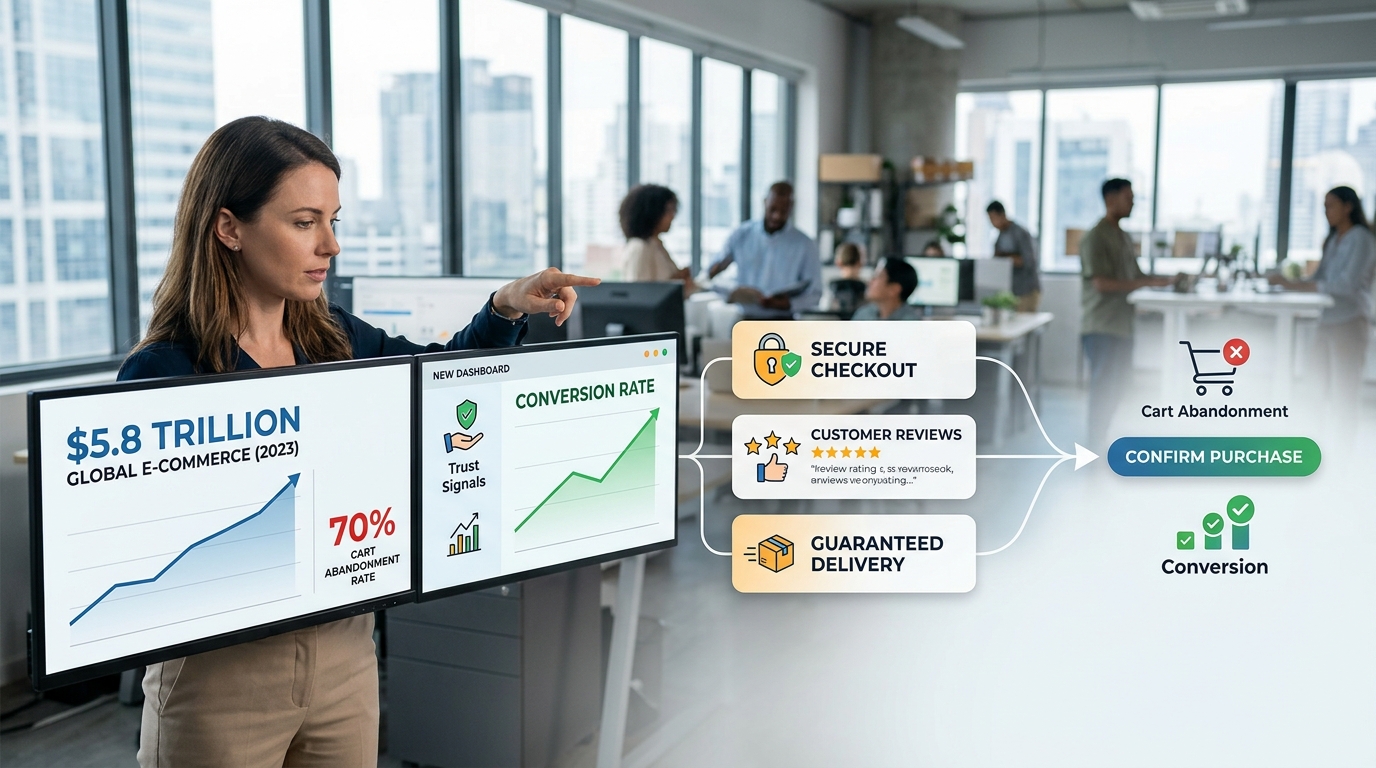
Trust is a measurable funnel variable, not brand fluff. With global e-commerce reaching $5.8 trillion and cart abandonment rates holding at 70%, trust signals represent one of the highest-leverage conversion optimization layers available—especially in checkout flows where payment security concerns and brand credibility uncertainty drive the majority of drop-off.
Key Points:
- Payment security concerns, brand credibility uncertainty, and insufficient social proof are the primary trust-related abandonment drivers—all addressable through tactical implementation
- Technical infrastructure (HTTPS), third-party certifications, social proof mechanisms (reviews, testimonials), and policy transparency function as measurable trust signal frameworks
- In emerging digital markets like India, cash-on-delivery dominates as a structural trust signal, enabling first-time buyers to complete purchases without pre-payment risk—demonstrating how trust mechanisms vary by market psychology
Why it matters: Most conversion optimization efforts focus on layout, copy, and CTA placement while ignoring the trust layer that determines whether prospects are willing to transact at all. Trust signals aren’t peripheral brand attributes—they’re tactical conversion levers with measurable impact on checkout completion rates. The difference between a generic “secure checkout” badge and a well-implemented trust signal system (SSL certificates, recognizable payment processors, verified reviews, transparent policies) can be the difference between 30% and 60% checkout conversion. This is especially critical for newer brands or markets where credibility hasn’t been established through brand recognition alone.
Trending Now
-
Agent Jesse for Real-Time Signal-Based Prospecting: Pioneering platform that triggers personalized outreach based on actual buyer behavior signals, not demographic assumptions
-
Warmly for Intent Capture: Captures warm intent from website visitors and routes to appropriate engagement sequences automatically
-
Ryze AI for Autonomous Optimization: Delivers continuous conversion optimization without manual test design or analysis
-
Replify AI Agents for Fitness Businesses: 24/7 member and prospect engagement handling lead capture, tour booking, and multi-channel follow-up without manual intervention
-
Smartlead.ai for Email Deliverability: Dominates email deliverability optimization, critical for scaling outbound without hitting spam filters
🎯 ABC Fitness Acquires Replify: Vertical-Specific Funnel Automation Becomes M&A Category
ABC Fitness’s acquisition of Replify marks a pivotal shift in how vertical-specific funnel automation is being valued and consolidated. Replify’s AI platform handles the entire lead-to-booking journey for fitness businesses—AI reception, lead capture, tour scheduling, class booking, and multi-channel communication via voice, text, email, and chat—all without manual intervention. This isn’t a feature add-on; it’s an intelligent operating system for gym sales and operations. (Read more)
🎯 The Customer Expectation Reset: How AI Is Rewriting Digital Experience
Generative AI is fundamentally reshaping customer expectations, and your funnel entry point is changing as a result. Once users experience conversational, context-aware AI systems, they expect all digital interactions to match that standard. Search is transforming dramatically—60% of searches now end without clicks, rising to 83% with AI summaries. Traditional SEO tactics are insufficient; success now depends on authoritative, well-structured content that AI systems can cite directly. Companies treating AI literacy as core strategy will capture outsized market share in a $2 trillion value opportunity. (Read more)
🎯 3-Hour Ascension System: Productized Funnel Frameworks Eliminating Sales Calls
Khan Marketing Dynasty launched the 3-Hour Ascension System, a digital training program automating customer journeys through three stages: low-ticket introductory offer, 45-minute evergreen webinar, and high-ticket upgrade opportunity—eliminating reliance on traditional sales calls. The framework includes webinar templates and offer structures. While brand-reported case studies claim $100M+ in collective client revenue, the productized funnel approach represents the broader trend toward automated customer journey frameworks that reduce manual sales intervention. (Read more)
🎯 Virgin Atlantic Compresses Weeks of Customer Journey Research Into Hours
Virgin Atlantic is using ChatGPT Work to revolutionize how teams understand and optimize the customer journey, compressing weeks of competitive research into hours. By creating unified dashboards through ChatGPT Sites, the company consolidated data from multiple sources into a single, customizable interface—eliminating navigation across separate tools. Product teams now manage roadmaps more efficiently while executives access simplified views, translating insights to faster product delivery. (Read more)
“Once users experience conversational, context-aware AI systems, they expect all digital interactions to match that standard. This shift is forcing organizations to abandon static content delivery and legacy segmentation in favor of real-time, personalized experiences.”
— Destination CRM, The Customer Expectation Reset
What’s your biggest funnel bottleneck right now?
- A) Lead generation and prospecting
- B) Conversion optimization and testing
- C) Trust signals and credibility
- D) Personalization at scale
The funnel infrastructure shift is happening whether you’re ready or not. AI-powered lead generation platforms are delivering 3-5x higher reply rates through signal-based prospecting. Autonomous CRO tools are optimizing continuously without manual testing cycles. And customer expectations are resetting around conversational, personalized experiences that most static funnels can’t deliver.
The performance gap between manually-operated funnels and AI-powered systems is widening every quarter. The companies winning aren’t just using better tools—they’re running categorically different customer acquisition systems. Your move is deciding which side of that gap you’ll be on six months from now.
Keep optimizing,
Funnel Marketing Systems Editor
📊 How did you like today’s email?
Originally published by Funnel Marketing Guy, your resource for funnel marketing, sales funnels, ClickFunnels, lead generation, conversion optimization, email marketing, marketing automation, and digital marketing strategies.
Continue your journey at https://www.funnelmarketingguy.com.
Enjoyed this issue?
Subscribe to get Funnel Marketing System delivered to your inbox every week.
Join 17 other subscribers • Free forever