
AI Just Changed How Buyers Find You—Here's How

|
Welcome to Funnel Marketing System!
Your conversion optimization strategy just got disrupted—and the fix isn’t what you think.
- 🎯 AI model upgrades deliver 47% conversion quality gains (5x industry benchmarks)
- 🧠 Predictive lead scoring architectures that actually move win rates
- 🔗 Agentic automation with CRM context for post-conversion plays
- 📊 When marginal gains matter: Apple’s 0.24% that became millions
AI Model Sophistication vs. AI Theater
You’ve seen the headlines. Everyone’s “using AI” now. But here’s what actually moved the needle in Q1 2026: KNOREX upgraded their KAIROS™ AI models and watched conversion quality surge 47% while CPA dropped 45%. Their click-to-conversion rate hit 10%—five times the 2% industry standard.
The difference? Model sophistication, not AI adoption. Gradient boosted decision trees instead of rule-based scoring. Neural networks trained on conversion patterns, not just engagement signals. Feature engineering that captures what actually predicts purchase behavior.
This isn’t about bolting ChatGPT onto your landing pages. It’s about rebuilding funnel infrastructure around predictive intelligence—from lead scoring to relevance optimization to agentic handoffs. The operators winning right now are treating AI as foundational architecture, not a feature add.
🔗 KNOREX Delivers 47% Surge in Conversion Quality and 45% Reduction in CPA Following Major KAIROS™ AI Models Upgrade (6 minute read)
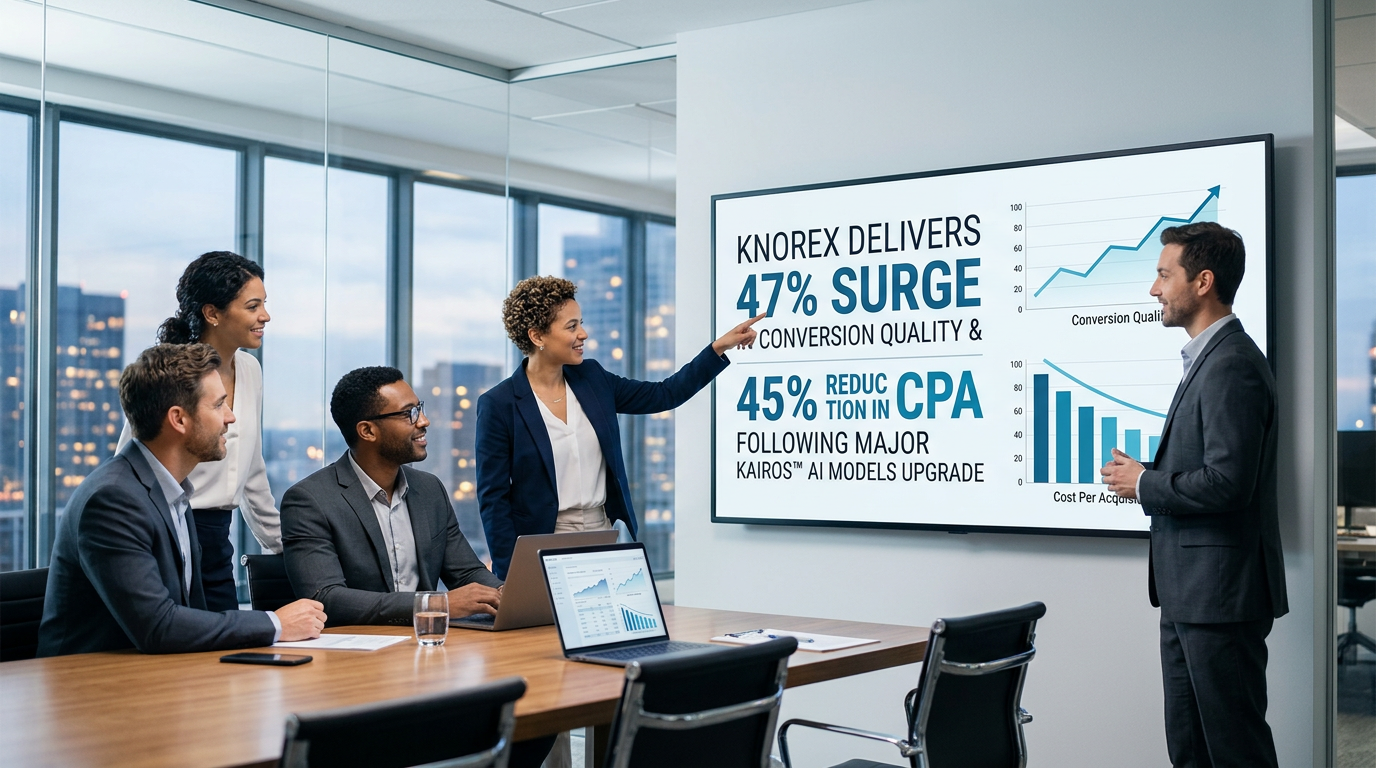
KNOREX Ltd. announced major upgrades to its KAIROS™ AI engine, shifting programmatic advertising from click-centric vanity metrics to outcome-driven economics. The enhanced models achieved a 47% improvement in conversion quality, 45% reduction in cost-per-acquisition, and click-to-conversion rates exceeding 10%—five times the industry benchmark of 2%. Live automotive campaigns saw performance uplifts ranging from 25% to 100%.
Key Points:
- Click-to-conversion rates hit 10% vs 2% industry average—a 5x improvement from model sophistication alone
- Automotive vertical campaigns showed 25-100% performance uplifts after AI engine upgrade
- Platform shift from engagement metrics to conversion economics strengthens advertiser retention and unit economics
Why it matters: This is proof that AI model upgrades—not generic “AI adoption”—drive bottom-funnel ROI. The 5x benchmark gap shows most platforms are optimizing for the wrong signal. When you rebuild scoring models around conversion patterns instead of click probability, CPA economics fundamentally change. The KNOREX results establish that outcome-driven AI beats engagement-driven AI every time, and the gap is measurable in your P&L.
🔗 Predictive Lead Scoring: Machine Learning Models, Propensity Analytics, and Sales-Marketing Alignment Technology (17 minute read)

Predictive lead scoring using machine learning has replaced rule-based systems at organizations reporting 30% increases in sales productivity, 25% improvements in win rates, and 50% reductions in time spent on unqualified leads. Machine learning architectures like gradient boosted decision trees and neural networks capture complex relationships traditional scoring misses, dynamically adjusting based on conversion patterns and behavioral data.
Key Points:
- Gradient boosted decision trees vs neural networks—each architecture captures different relationship types in conversion data
- Feature engineering determines model performance: comprehensive data integration from CRM, marketing automation, and product usage required
- Continuous model refinement based on real-world win/loss data prevents scoring drift and maintains predictive accuracy
Why it matters: Here’s the technical playbook for predictive scoring that actually moves productivity and win rates. The 30% productivity gain comes from sales reps spending time on leads the model flags as high-propensity, not leads that just downloaded a whitepaper. The architecture choice matters—gradient boosted trees excel at tabular data and feature interactions, while neural networks handle unstructured behavioral sequences. Success depends on thoughtful feature engineering, not just throwing data at an algorithm. Pair this with KNOREX’s conversion optimization to see AI working across every funnel stage.
🔗 Apple ran a test on the App Store to see if AI could improve search result rankings (5 minute read)

Apple researchers tested AI-generated relevance labels to boost App Store search rankings using a fine-tuned 3-billion-parameter language model. A worldwide A/B test revealed a statistically significant 0.24% increase in conversion rates—users downloaded apps more frequently. While seemingly modest, this translates to tens of millions of additional downloads annually given the App Store’s 38 billion downloads in 2025.
Key Points:
- 0.24% conversion lift seems small but equals tens of millions of incremental downloads at App Store scale
- Fine-tuned 3B parameter model generated millions of new relevance labels based on app metadata and user query patterns
- Improvement appeared across 89% of storefronts, demonstrating AI relevance scoring works globally
Why it matters: This is the scale case study showing marginal gains matter when volume is high. A 0.24% conversion increase would be noise in most funnels, but at 38 billion downloads it’s material revenue. The lesson for funnel operators: AI relevance scoring isn’t just for search giants. Apply the same approach to product recommendation engines, content personalization, or email subject line optimization. When you’re running millions of impressions, even fractional conversion lifts compound into real pipeline.
🔗 Salesforce Launches Agentforce Contact Center to Unify AI, Voice and CRM (14 minute read)
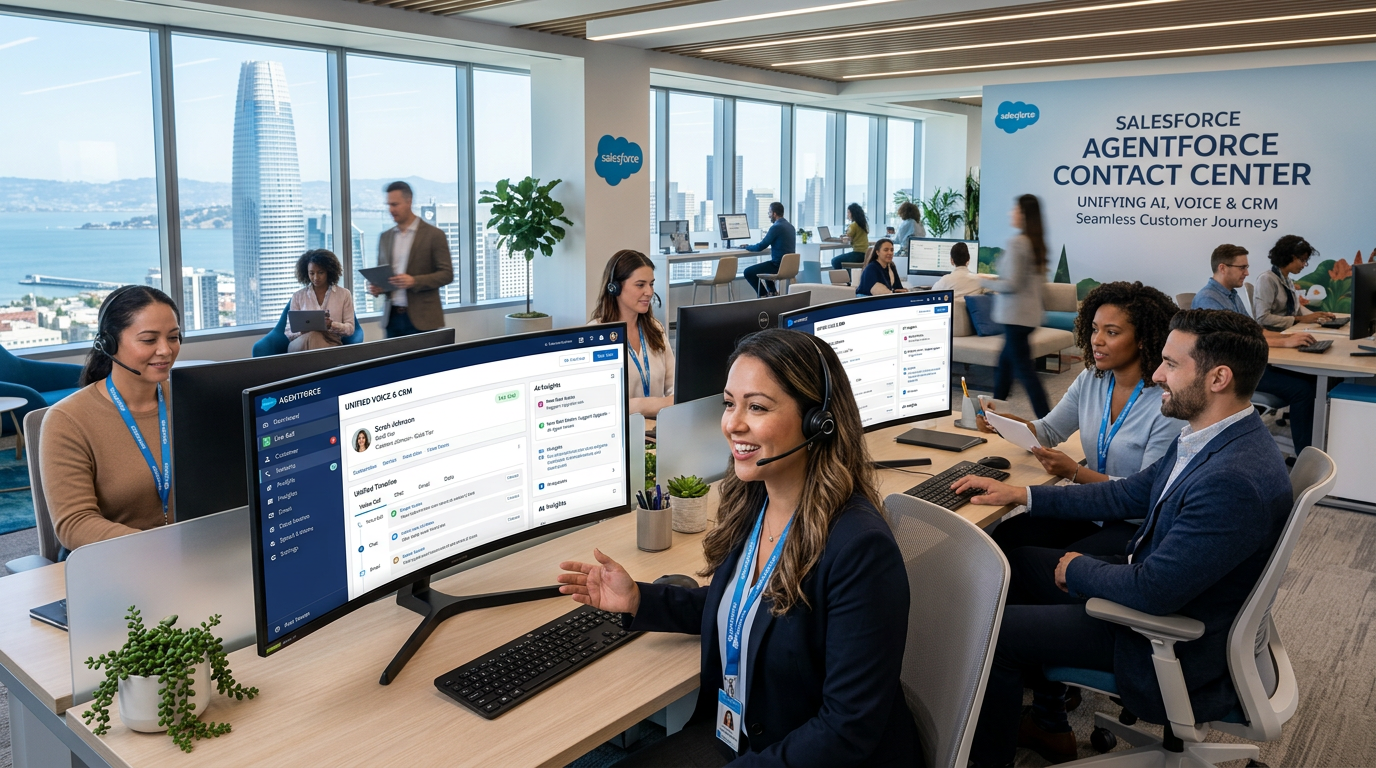
Salesforce launched Agentforce Contact Center, a unified platform natively integrating voice, digital channels, CRM data, and AI agents. The solution addresses fragmentation plaguing traditional contact centers built on disconnected systems, enabling seamless AI-to-human handoffs with complete customer context. Early adopters like Compass Working Capital and Savant Systems report automation of call summaries and data entry saving thousands of staff hours annually.
Key Points:
- AI-to-human handoffs maintain complete customer context from CRM, eliminating the “start from scratch” problem in traditional contact centers
- Native integration of voice, digital channels, and CRM data in single platform prevents data fragmentation
- Early adopters automate call summaries and data entry, saving thousands of staff hours while improving customer experience
Why it matters: This is post-conversion funnel optimization—how agentic AI handles nurture-to-close handoffs with full context. The traditional contact center stack loses customer journey data when passing from chatbot to human rep. Agentforce solves this by embedding AI agents directly into CRM, so every interaction carries forward conversion history, attribution data, and behavioral signals. For funnel operators, this extends your conversion optimization strategy beyond acquisition into retention and expansion. When AI agents have CRM context, they can personalize based on actual purchase history and engagement patterns, not just current session data.
🎯 Email Marketing Integration With CRM, Ecommerce & Sales Funnels Announced
GetResponse earned ‘Best Sales Funnel Software 2025’ recognition by enhancing email marketing integration with CRM, e-commerce, and sales funnel tools. According to Salesforce data, integrated marketing-sales technology delivers 299% ROI over three years and 60% conversion lift. The platform offers 150+ direct integrations and 1,500+ app connections via Zapier, serving 400,000+ clients globally. (Read more)
🎯 2026 Benchmark Report on B2B Marketing Automation in Australia
Australia’s B2B marketing automation adoption surged 30% in two years to reach 68%, according to HRS Agency’s 2026 benchmark report. Companies using automation report 300% ROI—double that of non-users—along with 50% faster lead response times, 75% reporting increased qualified leads, and 60% higher customer engagement rates. Businesses are strategically allocating 25% of marketing budgets to automation. (Read more)
🎯 Avoiding the pitfalls that stifle lead-generation
Flooring companies sabotage growth by making three critical lead-generation mistakes: treating all prospects identically despite different buyer behaviors, obsessing over vanity metrics like website traffic while ignoring conversion drop-off points, and clinging to legacy strategies as digital expectations evolve. Industry expert Lisbeth Calandrino reveals that winners embrace segmentation, analyze conversion gaps, and adopt innovative technologies including AI. (Read more)
🎯 Narada’s AI Strategy: Prioritizing Product-Market Fit Before Venture Capital
Narada, an enterprise AI company, challenged conventional startup wisdom by prioritizing customer focus over aggressive fundraising. Founder David Park conducted over 1,000 customer calls to identify core needs before scaling, discovering clients required AI tools understanding natural language and executing reliable action sequences. Park advocates treating early customer interactions as foundational research, believing sustainable growth stems from willingness-to-pay metrics rather than industry trends. (Read more)
“The intelligence behind purchase decisions now lives within AI platforms that don’t share insights back. Success requires treating AI as foundational infrastructure, embedding persistent identity, authenticated checkout, and loyalty directly into AI interfaces.”
— Retail AI Strategy Report, 2026
Which AI upgrade would move your conversion metrics most?
- A) Predictive lead scoring models
- B) AI-powered relevance optimization
- C) Agentic automation with CRM context
- D) Still figuring out what AI actually does
The pattern across every story today: AI model sophistication—not AI adoption—drives conversion economics. KNOREX’s 5x industry benchmark didn’t come from “using AI.” It came from rebuilding their prediction engine around conversion patterns instead of engagement signals.
The operators winning in 2026 are treating AI as foundational funnel infrastructure. Predictive scoring that routes reps to high-propensity leads. Relevance models that personalize at scale. Agentic handoffs that carry full CRM context. Each upgrade compounds into measurable productivity gains, win rate improvements, and CPA reductions.
Your move: audit where your funnel still runs on rules instead of predictions. That’s where the next 30% productivity gain lives.
Until next time,
Funnel Marketing Systems Editor
📊 How did you like today’s email?
Enjoyed this issue?
Subscribe to get Funnel Marketing System delivered to your inbox every week.
Join 17 other subscribers • Free forever