
AI Is Rewriting Your Marketing Funnel—Here's How


|
Welcome to Funnel Marketing System!
Your AI stack is humming, your content calendar is full, your attribution dashboard has 47 custom fields—so why is pipeline growth still flat? This week: the discipline gap between AI adoption and pipeline impact, the content system that proves ROI in four days, and why structural shifts demand funnel redesigns, not incremental tweaks.
- 🎯 The 91% adoption paradox: Why most teams can’t prove AI ROI—and the governance playbook that fixes it
- 🔍 AI search killed 59% of clicks but survivors convert at 23×—here’s the dual-optimization framework
- 🛠️ How to turn content from a cost center into a pipeline engine with behavior-mapped scoring
- 📊 Seven structural shifts forcing first-principles funnel redesign beyond tactical optimization
The Maturity Gap No One’s Admitting
You’ve adopted AI. Your team’s using it for content briefs, subject lines, maybe even ad creative. But when your CFO asks what it’s doing to CAC or deal velocity, you’re stuck pointing at activity metrics—emails sent, variants tested, hours saved.
The gap isn’t your fault. It’s a discipline problem masquerading as a technology one. And the winners aren’t the ones with the flashiest tools—they’re the ones who mapped AI to pipeline impact before they deployed it.
This issue walks you through three layers: the strategic framework that ties AI to revenue-critical goals, the tactical system that turns content into a funnel asset with measurable proof points, and the macro context explaining why these aren’t optimizations—they’re responses to structural shifts rewriting customer journeys entirely.
🔗 How to drive real ROI with AI in B2B marketing (16 minute read)

Ninety-one percent of B2B marketing teams have adopted AI. Only 41% can prove ROI. That’s not a technology problem—it’s a maturity gap. Most teams remain trapped in tactical uses like content generation, missing the strategic opportunities that separate high performers from the rest. The differentiator isn’t flashy tools. It’s discipline: mapping AI to pipeline impact, deal velocity, and revenue growth with sharp accountability structures.
Key Points:
- High-performing organizations align AI to revenue-critical goals first, embedding workflows into core systems with defined governance before scaling adoption
- The winners measure AI impact through pipeline metrics (CAC reduction, conversion lift, lead nurturing velocity) rather than activity metrics (content produced, hours saved)
- Moving AI from “content toy” to “pipeline engine” requires treating it as a thinking partner for strategy, not just an execution assistant—with accountability tied to business outcomes
Why it matters: Your CFO doesn’t care how many hours AI saved your content team. They care whether it moved CAC, shortened deal cycles, or improved conversion rates. This article delivers the governance framework and measurement discipline to answer that question with numbers. If you’re defending AI budget in 2026, this is the playbook: tie every AI deployment to a revenue-critical goal, establish clear accountability structures, and measure pipeline impact, not activity. The 91% vs 41% gap exists because most teams optimized for adoption speed instead of outcome clarity. Don’t be most teams.
🔗 The New Customer Journey: How AI Search Engines Are Rewriting the Marketing Funnel (7 minute read)
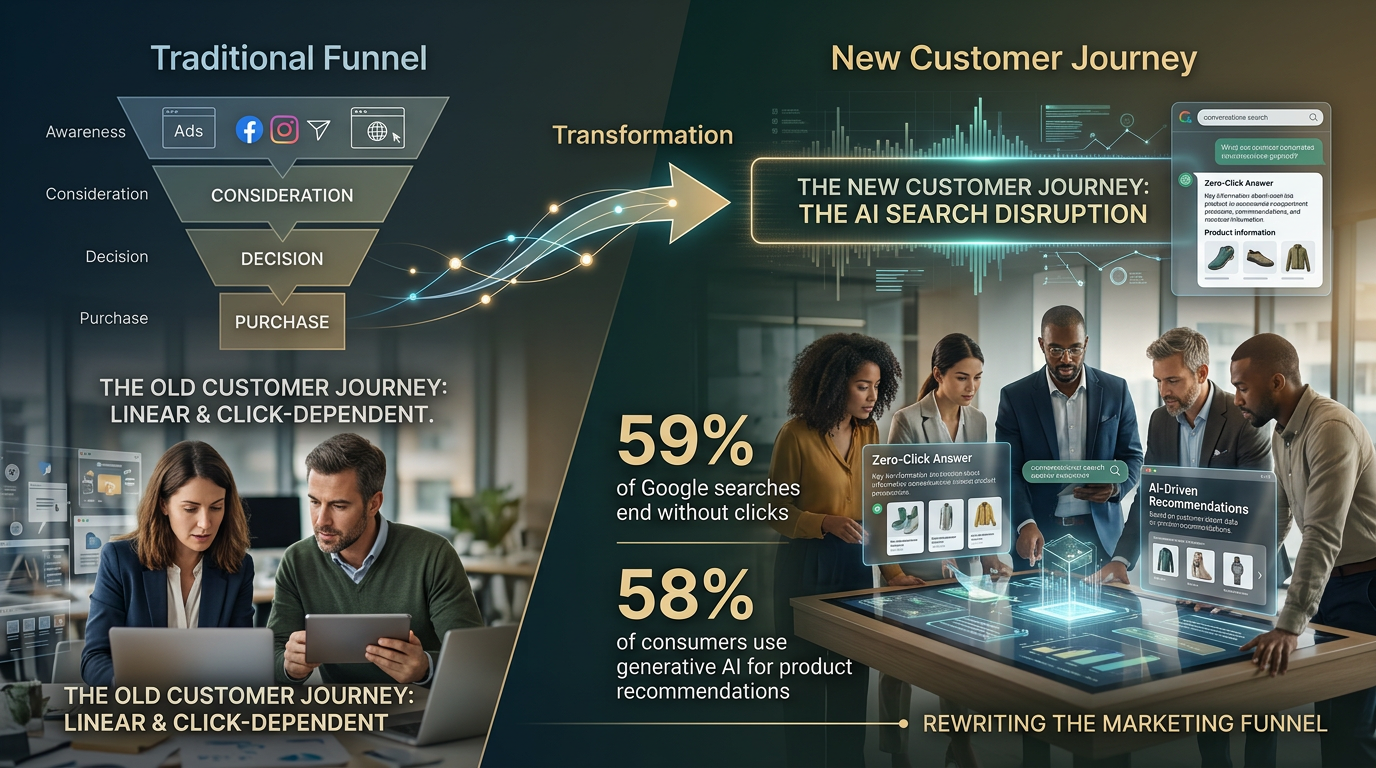
Fifty-nine percent of Google searches now end without clicks. Google AI Overviews appear in 13% of desktop searches, reducing click-through rates by 35%. You’d expect this to be a disaster for marketers. Here’s the paradox: AI referrals convert 23 times better than traditional organic traffic. The shift from “search and browse” to “ask and receive” is collapsing multi-touchpoint journeys into single conversations, and the winners are those optimizing for both traditional SEO and generative engine optimization (GEO) simultaneously.
Key Points:
- AI search engines are fundamentally disrupting attribution models—58% of consumers now use generative AI for product recommendations, compressing discovery journeys that once spanned multiple touchpoints into single AI-mediated conversations
- The 23× conversion advantage for AI referrals suggests these users arrive with higher intent and better qualification than traditional organic traffic, rewarding brands that earn citations in AI responses
- Success requires dual optimization: maintaining traditional SEO fundamentals while building citation-worthy authority through first-party data, direct customer interactions, and structured content designed for AI parsing
Why it matters: The 59% zero-click stat is the headline everyone’s panicking about. The 23× conversion rate is the strategic opportunity everyone’s missing. AI search isn’t killing your funnel—it’s filtering it. The traffic that survives is hyper-qualified, but only if you’ve built the authority to get cited in AI responses. This means rethinking content architecture for generative engine optimization (GEO): structured data, topical authority clusters, and citation-worthy depth that AI systems can parse and recommend. If you’re still optimizing solely for traditional SERP rankings, you’re building for a customer journey that’s already collapsing. The dual-optimization playbook is non-negotiable now.
🔗 DemandScience Introduces Patented Content-IQ to Increase AI Visibility and Marketing Yield for B2B Brands (6 minute read)

Eighty-one percent of B2B organizations report that half their content drives no measurable pipeline impact. DemandScience’s new Content-IQ system addresses this crisis by unifying AI visibility optimization, content architecture, and web personalization into a single platform. Using proprietary content opportunity scoring technology, it maps buyer behavior patterns into structured content clusters designed for both search engines and AI systems. The results from DemandScience’s own pilot: keyword rankings improved from position 85 to 34 within four days, with AI Overview inclusion achieved within five days.
Key Points:
- Content-IQ uses behavior-mapped opportunity scoring to transform content from volume-driven publishing into a revenue-aligned pipeline engine, prioritizing content that drives conversions over vanity metrics
- The system builds algorithmic authority through structured content clusters rather than chasing isolated keywords, optimizing for both traditional search and AI citation inclusion simultaneously
- Real proof points from DemandScience’s pilot demonstrate rapid impact: position 85 to 34 in four days shows the system identifies and exploits content gaps with precision
Why it matters: If 81% of your content isn’t driving pipeline, you don’t have a content problem—you have a prioritization problem. Content-IQ solves this by scoring opportunities based on buyer behavior patterns and conversion potential, not keyword volume or search difficulty. This is the tactical counterpart to the strategic frameworks in the previous articles: instead of guessing which content will move the needle, you’re mapping behavior to intent to conversion with a scoring system that feeds both AI search visibility and funnel progression. The four-day ranking jump isn’t magic—it’s what happens when you stop treating content as a publishing calendar and start treating it as funnel infrastructure. The bridge between “we create content” and “our content creates pipeline” is behavior-mapped scoring. This is what that looks like operationalized.
🔗 AI’s Impact on Business Transformation: Seven Structural Shifts (7 minute read)
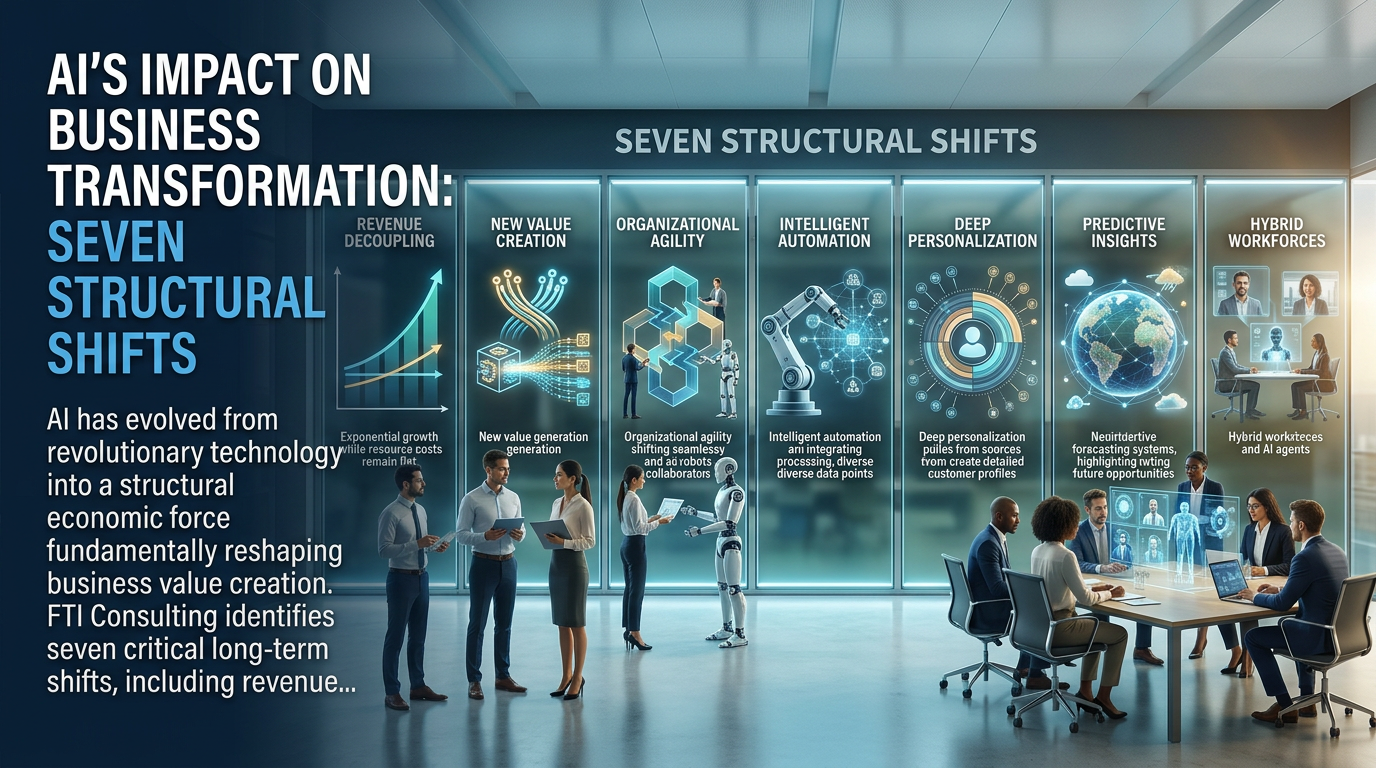
AI has evolved from revolutionary technology into a structural economic force fundamentally reshaping business value creation. FTI Consulting identifies seven critical long-term shifts: revenue decoupling from labor, evolving cost structures favoring automation, disrupted customer journeys, pricing compression, transformed revenue models, tightened workforce structures, and new competitive moats. The market has matured beyond hype cycles. Companies now face a critical divide: those treating AI as marginal efficiency tools risk incremental gains, while firms redesigning cost structures, revenue models, and talent strategies will emerge as market leaders.
Key Points:
- AI is decoupling revenue from linear customer journeys—traditional multi-touchpoint funnels are collapsing as AI-mediated interactions compress discovery, evaluation, and purchase into single conversations
- The shift from incremental efficiency gains to structural transformation requires first-principles thinking: redesigning revenue models, cost structures, and customer acquisition systems rather than optimizing existing processes
- Competitive moats now emerge from proprietary data, AI-native workflows, and business model innovation rather than traditional brand or distribution advantages
Why it matters: This is the macro context for why traditional funnel models are breaking. When customer journeys decouple from linear touchpoint sequences, attribution models built on multi-touch tracking become archaeological artifacts. When revenue models transform from transaction-based to AI-mediated subscription or usage-based structures, your conversion optimization playbook needs a rewrite, not a refresh. The companies winning aren’t the ones running better A/B tests on existing funnels—they’re the ones redesigning funnels from first principles to match how AI-native buyers actually behave. If you’re still optimizing for a customer journey that assumes sequential touchpoints and human-mediated research, you’re building for a world that’s already gone. The structural shifts aren’t coming—they’re here, and they demand structural responses, not tactical tweaks.
📊 Trending Now: Tools & Frameworks
-
Intellimize (Webflow Optimize): AI-driven personalization and automated traffic routing for CRO teams, starting at $14/month with 4.7/5 rating for real-time visitor segmentation and variant optimization
-
VWO Platform: Experimentation-heavy CRO suite with integrated analytics, scoring 4.6/5 for teams running concurrent multivariate tests across web and mobile
-
Unbounce Smart Traffic: Landing page optimization with AI-powered traffic routing, $22/month entry point, excels for no-code teams needing rapid variant deployment
-
Content Opportunity Scoring: Behavior-mapped prioritization framework that ranks content by conversion potential and AI citation likelihood rather than keyword volume
-
Generative Engine Optimization (GEO): Structured content optimization for AI search citation inclusion, focusing on topical authority clusters and first-party data integration
🎯 Social Feeds to Sales Funnels: How Social Commerce Is Reshaping Retail Growth
Social commerce exploded from 2.4% to 7.2% of US e-commerce between 2018-2025. TikTok Shop captured 22.1% market share in just 18 months since its 2023 launch by collapsing the funnel into the feed—discovery, evaluation, and checkout happen in a single scrolling session. Fashion, beauty, and electronics lead adoption in visually driven categories where creator-led discovery compresses traditional product research cycles. The shift forces retailers to architect for platform-native conversion while maintaining attribution visibility across fragmented touchpoints. (Read more)
🎯 Master the Customer Journey with Analytics and Personalization
New Adobe research quantifies the friction tax: 94% of consumers have experienced disconnected journeys and would switch competitors after persistent fragmentation. Sixty-nine percent abandon purchases when forced to re-enter details across channels. The cost isn’t just abandoned carts—it’s lifetime value erosion. Real-time customer journey analytics outperform post-mortem attribution by identifying friction at handoff points (channel switches, device changes, re-authentication loops) before conversion drops. Companies acting on feedback see measurable loyalty lifts, with 91% of consumers increasing commitment to responsive brands. (Read more)
🎯 Why the Era of Viral Marketing Is Over
Viral campaigns are dead. As markets grow volatile and capital tightens, splashy creative pivots no longer deliver sustainable growth. Marketing leaders must embrace the “First Down Philosophy”—disciplined, incremental optimization of operational fundamentals. This means fixing unglamorous inefficiencies: reducing response times, tightening email loops, eliminating friction in conversion funnels. By stacking small gains, leaders build resilient systems that absorb failures and generate compounding returns. The shift from creative visionary to operational architect is essential. Success now comes from mastering yield-per-dollar efficiency, not chasing dopamine hits from big ideas. (Read more)
🎯 Crafting the customer e-journey: The role of digital anticipation nudges
Academic research testing 2 million shoppers proves that showing customers “what happens next” significantly reduces cart abandonment, especially for high-risk purchases. Digital anticipation nudges—strategic UI elements providing information about upcoming delivery stages—help consumers psychologically anticipate future journey steps, reducing perceived risk and uncertainty. With 75% of consumers abandoning carts before purchase, this research offers retailers a cost-effective, psychology-driven tactic to enhance conversion. The anticipation effect works by giving customers confidence in post-purchase experience before they commit, addressing the uncertainty gap that triggers abandonment. (Read more)
🎯 Swell Country: Proven Lead Generation and Digital Marketing Strategies
Swell Country’s track record demonstrates the integration multiplier effect: clients captured over 450,000 leads and generated $200 million in attributed sales by treating SEO, paid media, and content as a unified acquisition system rather than parallel campaigns. Notable achievements include scaling an ecommerce brand from $200,000 to $10 million annually and delivering 9.4× ROAS with double-digit conversion improvements. The lesson isn’t about channel tactics—it’s about orchestration. When search visibility, paid acquisition, and content nurturing operate as a single system with shared attribution and feedback loops, the compounding effect outperforms siloed optimization by orders of magnitude. (Read more)
🎯 Are we in danger of marketing automation outpacing strategy?
Your stack is getting smarter while your results plateau. The automation paradox: teams deploy sophisticated AI and automation tools reactively, without strategic planning or outcome clarity. This leads to efficient execution of mediocre strategies—you’re just automating mediocrity faster. The solution requires a strategy-first framework: define revenue-critical goals, map automation to pipeline impact, establish governance and accountability structures before scaling deployment. Technology should serve business objectives, not drive them. If you can’t articulate how a tool moves CAC, deal velocity, or conversion rates before you deploy it, you’re contributing to the paradox. (Read more)
“The market has matured beyond hype cycles. Companies now face a critical divide: those treating AI as marginal efficiency tools risk incremental gains, while firms redesigning cost structures, revenue models, and talent strategies will emerge as market leaders.”
— FTI Consulting, Business Transformation Research
Which funnel metric are you prioritizing in Q2 2026?
- A) CAC reduction through AI-powered lead qualification
- B) Conversion rate optimization via behavioral personalization
- C) Pipeline velocity improvement through content scoring systems
- D) Attribution model redesign for AI-collapsed customer journeys
The through-line across this issue isn’t subtle: AI adoption without pipeline accountability is theater. Content creation without behavior-mapped scoring is waste. Funnel optimization without acknowledging structural shifts is rearranging deck chairs.
The 91% adoption rate proves everyone has AI. The 41% ROI proof rate reveals most teams never mapped it to revenue-critical goals before deployment. The 59% zero-click searches show traditional funnels are collapsing. The 23× conversion rate for AI referrals proves the new game rewards those who optimize for citation authority, not just keyword rankings. The 81% of content driving zero pipeline impact demonstrates that volume without scoring is noise.
You don’t need more tools. You need more discipline. Governance frameworks that tie every AI deployment to CAC, deal velocity, or conversion lift. Content scoring systems that prioritize based on buyer behavior and pipeline potential. Attribution models that acknowledge customer journeys no longer follow linear touchpoint sequences. These aren’t optimizations—they’re structural redesigns responding to structural shifts.
The winners in 2026 won’t be the teams with the best AI stack. They’ll be the ones who redesigned their funnels from first principles to match how AI-native buyers actually behave, measured pipeline impact instead of activity, and built systems that prove ROI in four days instead of defending adoption rates in quarterly reviews.
Until next time,
Funnel Marketing Systems Editor
📊 How did you like today’s email?
Enjoyed this issue?
Subscribe to get Funnel Marketing System delivered to your inbox every week.
Join 17 other subscribers • Free forever